High Holding Power Anchor With Great Gripping Force

TThe anchor has a large holding power to weight ratio, so it is called a high holding power anchor. The gripping force is more than two times larger than the ordinary stockless anchor of the same weight. There are Martrosov anchor, Danforth Anchor, Schdringer anchor, Staccato anchor, etc.

A high holding power anchor is classified into a stocked anchor and a stockless anchor. Its general feature is that the anchor fluke is wide and long with deep gnawing soil, good stability.

1.Stocked high holding power anchor

The typical kinds of this anchor are the Danforth anchor and Steven anchor.

The anchor head is provided with a stabilizer bar to ensure stability, generally suitable for more soft substrates, with inconvenient storage, so this type of HHP anchor is suitable for engineering ships and small ships.

Danforth anchor

The danforth anchor is also known as swallow anchor and the anchor fluke is rotated about 30 ° back and forth. The holding power to weight ratio is generally greater than 10, mostly used in engineering vessels.

danforth anchor

Steven anchor

The anchor has a short and large fluke, and the maximum angle of the anchor fluke can be adjusted by the movable wedge mounted on the anchor rod to accommodate a variety of substrates. The holding power to weight ratio is 17 to 34, widely used as a positioning anchor for oil platforms.

2.Stockless high holding power anchor

The stockless HHP anchor is developed by the stock HHP anchor. It has improved the anchor fluke of the stockless anchor. The typical stockless high holding power anchor is the AC-14 anchor developed by the United Kingdom and the Boer anchor developed by the Netherlands.

AC-14 anchor

The AC-14 anchor is a commonly used anchor. The anchor fluke can have an allowable deviation for the left and right corner within 1 degree. AC-14 anchor is a casting anchor with black painting surface treatment. It has the advantages of stable structure, thick and wide flukes, adaptability to various substrates, rapid gnawing, high gripping stability with holding power to weight ratio ranges from 12 to 14. So it is commonly used as the bow anchor in the large ship or ro-ro ship.
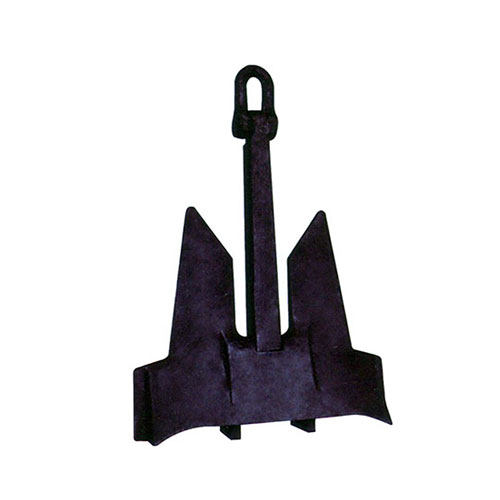
AC-14 anchor

Boer anchor

The Boer anchor also called TW type anchor or N type anchor. It has smooth and sharp anchor flukes, with the advantages of adapting to a variety of substrates, high stability, convenience for dropping and weighing anchor, easy for storage, suitable for the bow anchor in a large ship and positioning anchor in a workship.
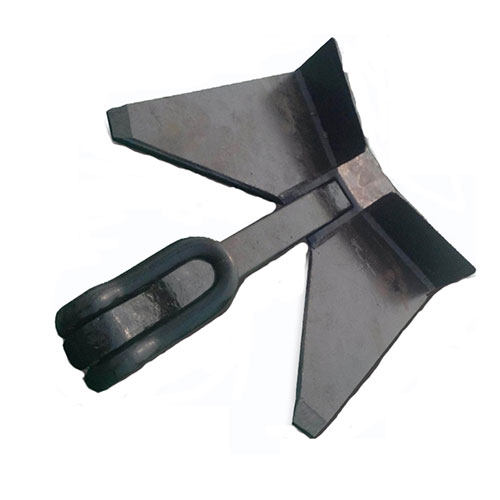
TW type anchor

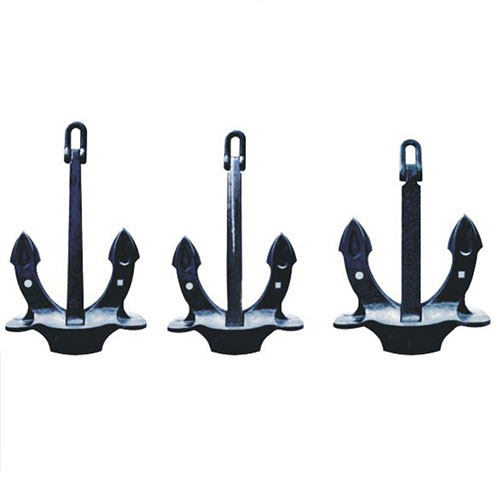
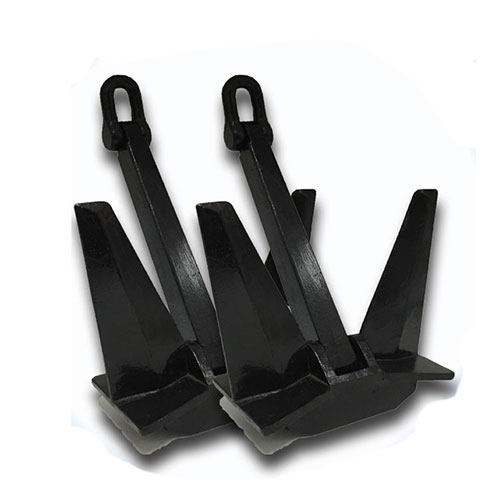
The high holding power anchors, which include Danforth anchor, AC-14 anchor, TW type anchor, etc, have the advantages of great gripping force, deep gnawing, high stability, commonly used in a wide variety of ships.
Why Should Choose Marine Anchor For Berthing

The boat is difficult for berthing when encountering the strong wind. It completely relies on boat anchor. The marine anchor is the main component of the anchoring and mooring system. One end is fixed on the boat with a marine anchor chain and the other end is a barbed claw shape, throwing to the bottom of water or shore to highly stabilize the boat.

Work Principle Of Marine Anchor

Marine anchor is composited of anchor buckle, anchor bolt, anchor stock, anchor handle, anchor wrist and the symmetrical part on both sides is called anchor fluke which is the most important part of the anchor to grab into the dirt. After the ship is anchored, the anchor is sinking to the bottom of water under the traction of the anchor chain. The plane where the anchor wrist is located is perpendicular to the water bottom with the anchor rod. At this time, the anchor fluke will be in contact with the bottom of the water.

The length of the ship anchor chain is often longer than the depth of the water, so the anchor chain in the water bottom has a lying- flat state. When the ship is disturbed, the anchor chain will be pulled. The anchor in the bottom of the water under the action of the horizontal force. The role of the anchor itself acts on the contact point of the anchor fluke and the water bottom. The two-force synthesis makes an anchor move downward, which is anchoring the process. After that the anchor is pulled into the bottom of the water, which can provide the ability for boat berthing.

The Categories Of Marine Anchor

The factors that should be considered for choosing the marine anchor include easy operation, convenient to store and economic application. The most important factor is the anchor grip. The anchor grip is different because of the anchor type and the submarine soil.

There are many kinds of marine anchors. According to the different structures and uses, the ship anchor can be classified into a stocked anchor, stockless anchor, high holding power anchor and special anchor. The bow anchor adopted by the merchant ship is a stockless anchor, while the stern anchor sometimes adopt a stocked anchor or a Danforth anchor.

1. Stocked anchor

The anchor has the advantages of a simple structure, large holding power to weight ratio and high grip stability, but it has inconvenient anchoring operation and storage with an anchor stock. Therefore, this anchor should not be used as a bow anchor for commercial ships, suitable as a stern anchor, generally used for small boats.

2. Stockless anchor

It is also known as the hall’s anchor and the generally adopted stockless anchors for merchant ship are Hall anchor and Spek anchor. The anchor fluke and anchor rod can rotate at a certain angle and is a stockless type. The holding power to weight ratio is 2.5 to 4 and the maximum is up to 8. The anchor has a simple structure, throwing anchor operation and storage conveniently, so it is suitable for the bow anchor with the widest applications. But it also has the disadvantage of a small anchor grip. The Hall anchor is the earliest used type and the Spek anchor is an improved type of Hall anchor, which has the advantage that its anchor fluke can be naturally upward.

hall anchor

3.High holding power anchor

It is combined with the advantages of a stocked anchor and a stockless anchor. Because of the large gnawing soil of the anchor fluke and the large gripping force, it is suitable for the sandy or soft water bottom. The commonly used HHP anchors are the Martrosov anchor and Danforth anchor which is characterized by the deep gnawing soil, high stability, with large anchor grip. But the strength of the anchor fluke is weak and easy to deform.

high holding power anchor

4.Special anchor

It has different shapes, compared to the general anchors, such as single claw anchor, screw anchor and mushroom anchor. It often has special applications, used in a permanent mooring such as a floating tube, a buoy, a lightboat, the floating dock and a floating wharf.

For more professional knowledge, please visit the article page of What is a marine anchor

Material Properties Of Tungsten Carbide

carbide wear parts

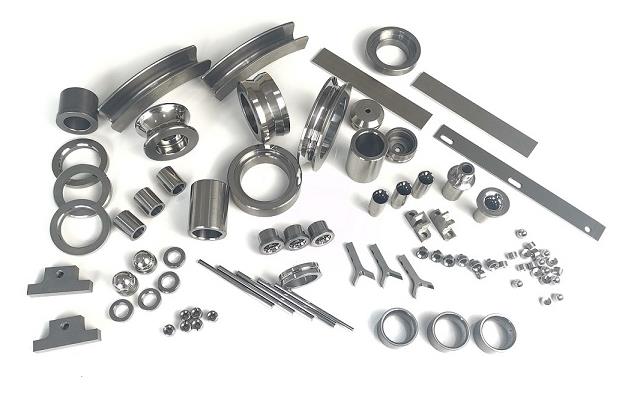
Tungsten carbide is made of refractory metal hard compound (hard phase),which is generally a carbide, and metal binder (binding phase)obtained by powder metallurgy method,. As a hard alloy for cutting tools, the commonly used carbides are tungsten carbide (WC), titanium carbide (TiC), and tantalum carbide(TaC), niobium carbide (NbC), etc. The mostly used binder is Co. The strength of the tungsten carbide depends mainly on the content of cobalt.

Because of the high melting point,high hardness, good chemical stability, and good thermal stability that carbides in the cemented carbide have and the large amount of high-temperature carbon materials, the hardness and resistance Abrasiveness and heat resistance are higher than high speed steel.

The main component of the hard alloy hard phase is WC. WC has good wear resistance.although some carbides have the same hardness and WC, but do not have the comparable wear resistance. Besides,WC has a higher yield strength (Table 1-2), so its resistance to plastic deformation is better. WC has good thermal conductivity, which is one of the most desirable properties for making tool materials. In addition. WC has a low coefficient of thermal expansion that is about 1/3 of steel.WC’s modulus of elasticity is three times that of steel, and its torsional modulus is twice that of steel. Therefore, the compressive strength of cemented carbide is also higher than that of steel. In addition, WC has good corrosion and oxidation resistance at room temperature, good electrical resistance, and high flexural strength. these excellent properties of WC have been passed to a hard alloy with its main component.

Compared with high speed steel, the hardness of cemented carbide is HRA89-94, which is much higher than the hardness of HSS (HRC63-70 or HRA83-86.6). The maximum cutting temperature allowed for tungsten carbide can reach 800-1000 °C or more, which could be much higher than HSS’s (550-650 ℃). The high temperature hardness of cemented carbide could be HRA82-87 at 540 °C,which is the same as the normal temperature hardness of high speed steel. The hardness at 760 ° C is HRA 77-85, and can maintained in HRA 73-76 at the environment of 1000-1100 ° C. Besides, Carbide’s wear resistance of cemented carbide is 16-20 times higher than that of the best HSS. Due to its high temperature hardness and wear resistance, cemented carbides have much higher cutting performance than high-speed steel and can increase tool durability by several tens of times. When machining ordinary structural steel, the cutting speed allowed is 4-10 times higher than that of high speed steel tools.

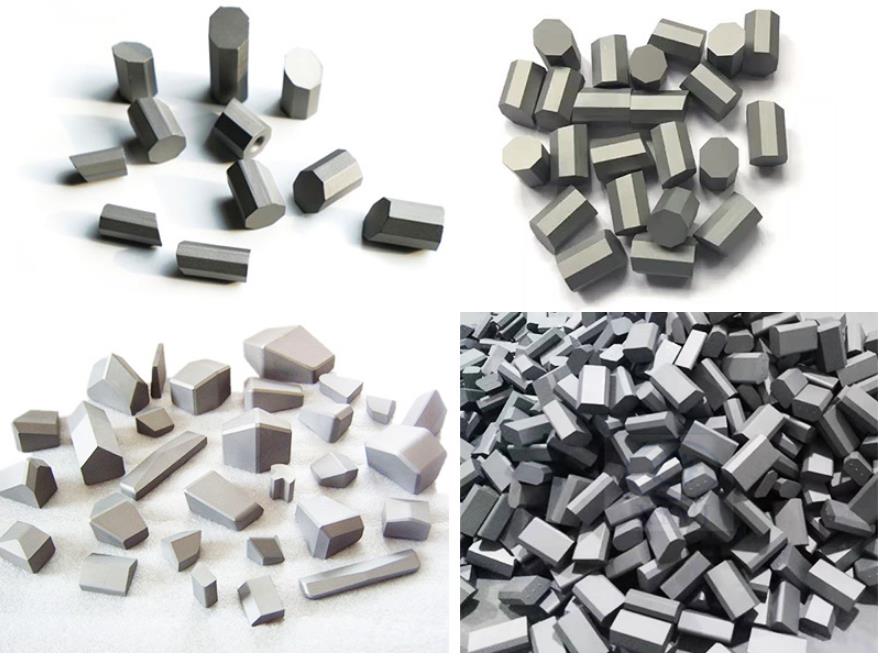
Tungsten carbide is widely used as tool materials, In the turning process, except for a small number of small diameter bores and some non-ferrous metal workpieces, almost all of them can be processed with carbide turning tools. In the drilling process, in addition to the existing carbide drills, carbide drills, deep hole drills, carbide injection drills and indexable carbide drills have also been successfully used to machine steel. In addition, carbide end mills have been widely used. Others such as reamer, end mill, small modulus gear hob, medium and large modulus gears for hard tooth surfaces, broaches and other tools use hard Alloys are also increasing. Although the proportion of cemented carbide in tool materials is lower than HSS and ranks second, its proportion of cutting chips is as high as 68%. According to reports, in some countries, more than 90% of turning tools and more than 55% of milling cutters are made of tungsten carbide, and this trend continues to grow.

Why Choose cemented carbide as the material of mining tool

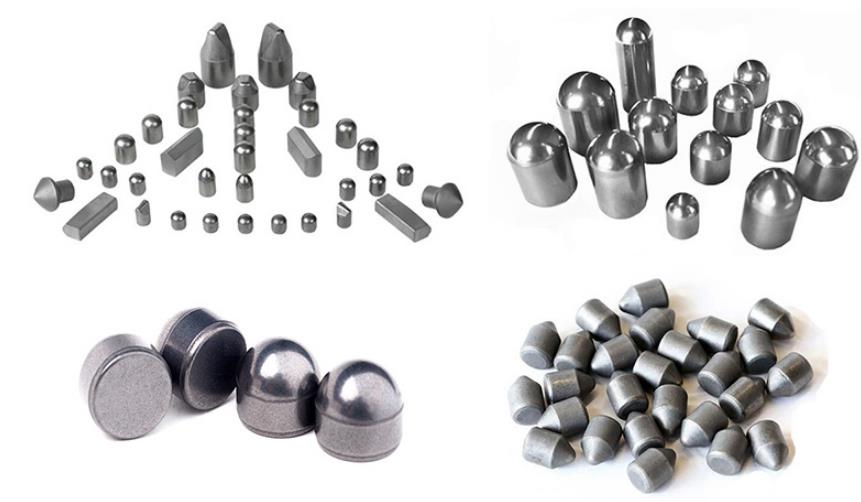
An excellent hard alloy for mining should have high strength, high hardness required for abrasion resistance and high toughness required for resistance to impact fracture. Because of the high hardness, wear resistance, and stable chemical properties, tungsten carbide mining tool is widely used.

tungsten carbide mining buttons

1. Wear resistance of WC alloy

The shearer of the shearer is in direct contact with the coal seam during the working process. The abrasive wear characteristics of the shearer are closely related to the coal seam structure and hardness. The hardness of the coal is low, generally 100 to 420 HV, but the coal often contains different hardness. Impurities such as quartz and pyrite (900 to 1100 HV) have high hardness and have a great influence on the abrasive wear characteristics of picks.

In most of the operating examples, wear resistance is a basic function of material hardness. The higher the hardness, the higher the abrasive wear resistance. Pure WC is very hard and similar to diamond. In cemented carbide, WC particles form a strong skeleton, so WC cemented carbides exhibit very high hardness. In addition, WC belongs to the hexagonal crystal system and has anisotropy in hardness. The Vickers hardness of the bottom surface and the edge surface is 2 100 HV and 1 080 HV, respectively. In the coarse-grained cemented carbide, the proportion of WC grains on the plane is high, and thus the carbide containing the coarse-grained WC shows higher hardness. At the same time, at a high temperature of 1 000°C, coarse-grained WC hard alloys have higher hardness than ordinary hard alloys and show good red hardness.

In the coal cutting process, WC particles are exposed on the surface of the cemented carbide after cemented phases of the cemented carbide in the tool nose protected by the built-up edge have been squeezed away or are carried away by abrasive scraping. Bonded phase-supported WC particles are easily crushed, destroyed and released. Due to coarse WC grains, the cemented carbide has a strong holding force with respect to the WC, and the WC grains are difficult to pull out and exhibit excellent wear resistance.

carbide mining tips

2.Toughness of WC Alloy

When the cutter bit cuts the coal rock, the cutter head is subjected to high-stress stress, tensile stress and shear stress under the action of the impact load. When the stress exceeds the strength limit of the alloy, the alloy cutter head will be fragmented. Even if the generated stress does not reach the strength limit of the cemented carbide, the fatigue cracking of the cemented carbide will occur under the repeated action of the impact load, and the expansion of the fatigue crack may cause the tool head to fall off or chipping. At the same time, when cutting the coal seam, the shearer pick produces high temperature of 600-800°C on the cutting surface, and the cutting cutting coal seam is a periodic rotary motion. The temperature rise is alternating, and the temperature increases when the cutter head contacts the coal rock. , cool down when leaving the coal rock. Due to the constant change of the surface temperature, the dislocation density increases and concentrates, and the surface of the serpentine pattern appears.

The depth of cracks and the rate of propagation decrease with increasing carbide grain size, and the morphology, direction, and depth of cracks also vary with WC grain size. The cracks in fine-grained alloys are mostly straight and small and long; coarse-grained alloy cracks are irregular and short. The cracks mainly extend at the weak grain boundary. In the coarse-grained cemented carbide, if the micro-cracks bypass the coarse-grained WC grains, they are zigzag-shaped and must have energy that matches the fracture area; if they pass through When WC grains are expanded, they must have considerable fracture energy. As a result, the coarse-grained WC grains have enhanced deflection and bifurcation of cracks, which can prevent the further propagation of micro-cracks and increase the toughness of the cemented carbide. With the same content of cementitious phase, the coarse-grained alloy has a thicker bonding phase, which is beneficial to the plastic deformation of the bonding phase, inhibits the extension of cracks, and shows good toughness.

Studies on the strength and structure of WC-Co cemented carbide also show that there is a certain rule between the strength of tungsten carbide and the grain size of WC. When the cobalt content is constant, the strength of conventional low-cobalt alloys always increases as the grain size of WC in the cemented carbide becomes coarser, and the strength of the alloy with higher cobalt content peaks with WC grain coarsening.

CNC Milling

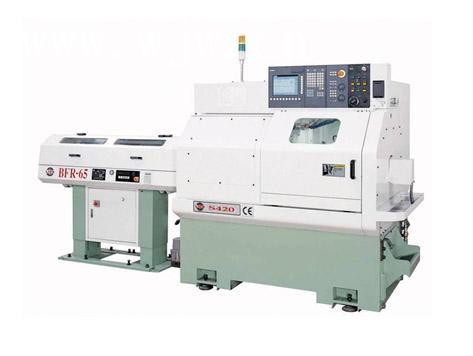
CNC Milling is a very important part in a part producing process, it provides precise slots or ribs of various sections, flat surface in vertical, horizontal and inclined planes, surfaces of revolution, helical grooves and more. Compared with CNC turning, CNC milling, especially 5 axis milling can be used to create complex 3D shapes or to apply a machined surface or features to parts made both plastics and metals. The advantage of multi-axis milling machines makes CNC milling process versatile, as well as accurate and repeatable, for creating many different types of part features of complex geometries. Example include holes, curves, slots, angled shapes, and channels. Milling is also ideal for making tooling for pressure die casting and plastic injection molding.

Metal Casting Service

JTR Machine offers industrial metal casting services for Aluminum, Steel, Zinc, etc. Capable of both mass production and prototyping, JTR Machine has provided many high-precision prototypes and end-use parts to our clients. JTR CNC machining is available to combine with metal casting and produce parts with finer surface details (surface finishing available, too). Best solution for large volume parts production, contact us and get an instant quote.

CNC future trend

CNC machining is about to change into a brand new form, process will be composed into an integrity to encounter the customer’s need. CNC is the abbreviation of Computerized Numerical Control, which is an automatic machine tool to replace the program control system. CNC machining is able to solve the problem of complex, precise, small batch, and multi-variety parts processing ably, for it’s a flexible, high efficiency automatic machine tool. It represents the development direction of modern machine control technology and is a typical mechatronics product.

New technology:

The promotion and popularization of five-axis linkage processing technology is the direction of the the future development.

Complex curved surface machining is a common process in industry, and many key-parts structures and processing techniques of ship, plane, rocket, satellite and spaceship need certain speciality and processing difficulty, while traditional cnc machining is not capable of finishing it. So a five-axis linkage, high-speed, high-precision CNC machine tool must be used to meet the processing requirements. The the features of five-axis linkage CNC machine are as widely used, high processing accuracy and work efficiency, which just as to match the future CNC machining trend.

New format:

The demand for single machine tools that complete a single process is gradually reduced, and the demand for flexible manufacturing cells that complete multiple processes is gradually increasing

As the demand for single machine tools is declining, the flexible manufacturing cells are getting more popular.The flexible manufacturing cell formed as a single or many five-axis machining centers or composite machining centers with small automated logistics devices so as to meet the requirements of high-efficiency processing of multi-variety and small-batch parts.But the intensified competence among downstream enterprise, the rising costs, and especially the rising cost in labor which is in a lager lack of than before, the three factors led to the emergence of more unmanned manufacturing systems. And at the same time, downstream customer’s rising demand of flexible manufacturing cells indicted an increase of the processing market with many varieties and small batches. The flexible manufacturing unit will appear as a complete set of equipment of “CNC machine tools + small logistics devices (industrial robots, automatic pallet exchange, truss manipulators, etc.)” to solve the pain points of the sharp rise in labor production costs, and achieve unmanned.

New mode:

Development from single product sales to intelligent manufacturing system integration solutions.

Over the last few years, downstream enterprise has put new requirements to CNC machines provider, and they are more inclined to cooperate with the providers who could provide a complete set of manufacturing equipment, a set of perfect solution for project and show abilities for more complex projects underwriting and automatic transforming. The provider who owns automatic, flexible, and intelligent production line in manufacturing can please custom CNC machining, so on keep customer’s rely on him. Besides, national and local policies inspire manufacturing enterprises to develop into automatic mode, and it stimulate the transformation of intelligent manufacturing equipment suppliers to intelligent manufacturing system integration CNC machining service providers, which includes custom CNC machining, service 3d printing service and surface finishing service,etc.

JTR CNC TURNING SERVICE

CNC turning is in a going-up demand, and it’s getting more important in Industrial production. with access to a network of over 2,000 Europe-based manufacturers with CNC lathes and turning centers, Xometry provides us with the capacity and capabilities for various project needs, while also delivering the most competitive pricing and lead times. Good machine learning-trained technology also provides instant manufacturability feedback to ensure that our part fits the requirements we need and is optimized for the CNC turning process. If you are looking for CNC turning service I do recommend you JTR CNC Turning service.

Why Choose Tungsten Carbide Nozzle

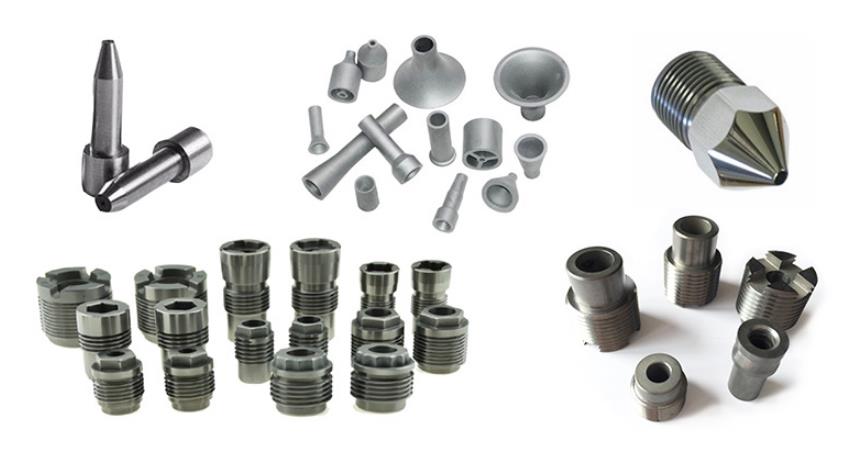
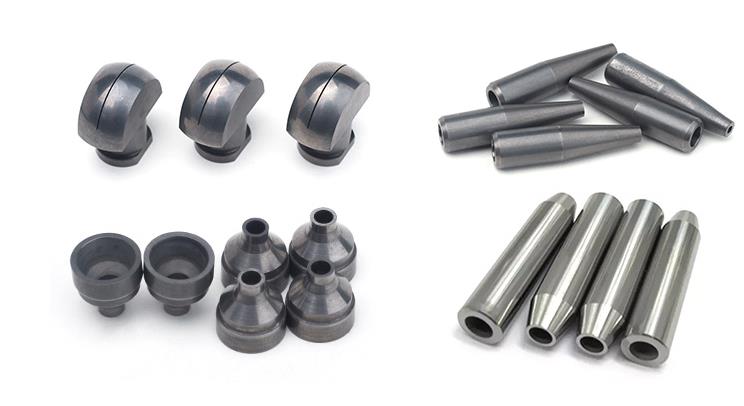
Tungsten carbide nozzle is made of precision machinery and cemented carbide material (superhard alloy). The bending resistance is 2300n / mm and the hardness is hra90 degree. When machining XYMJ cemented carbide nozzle, it provides precision grinding and surface treatment to achieve the hole roughness of ra0.1 and the roughness of both ends of R is Ra0.025. There is a scientific radius of curvature design at the two entrances. This design ensures the smooth passage of the thread. Due to the whole material processing, there is no elevation angle on the drilling hole, and the bending and blocking phenomenon has been improved compared with ruby nozzle. Carbide nozzle is made by hot pressing and sintering hot straight hole and hill hole. Because of its hardness, low density, excellent wear resistance and corrosion resistance, tungsten carbide nozzle has been widely used in sand blasting and shot peening equipment, which ensures that the product can be used in the best air and abrasive for a long time.

Carbide nozzle

Advantages

Carbide nozzle and other nozzles: common nozzle materials include cast iron, ceramics, tungsten carbide, silicon carbide, boron carbide. Ceramic nozzles are only used in non aggressive light equipment and abrasive in explosion cabinets. Tungsten, silicon, and boron carbide are the most popular blasting applications due to their long service life. The following is a list of carbide nozzles and their comparison with other nozzles.

Approximate service life per hour

Nozzle material: steel shot / sand sand / alumina

Carbide nozzle 500-800 300-400 20-40

Alumina nozzle 20-40 10-30 1-4

SiC nozzle 500-800 300-400 50-100

Boron carbide nozzle 1500-2500 750-1500 200-1000

Types

The shape of nozzle hole of cemented carbide determines its air flow pattern. The nozzle generally has a straight hole or a limiting hole, a hill hole.

cemented carbide nozzle

1. Straight hole : the straight hole nozzle forms a sealed air flow mode for on-site or internal air flow. This facilitates the realization of small tasks, such as cleaning parts, weforming, cleaning handrails, steps, plaques, or stone carvings and other materials.

2. Traditional long hill design

3. The orifice nozzle forms a sufficient airflow pattern, and the grinding speed can be increased up to 100% for a given pressure. The best choice of Venturi surface is to improve the productivity of the nozzle. Compared with the straight hole nozzle, the productivity of the long mound nozzle can be increased by 40% when the abrasive consumption is about 40%.

4. Double venturi: Double venturi and wide throat nozzle are the enhanced version of long venturi nozzle. The double dome style can be thought of as having two nozzles between a set of slits and holes to allow the incoming atmosphere to enter the downstream section. The outlet end is also wider than the traditional nozzle. These two modifications are made to increase the size of the airflow pattern and minimize abrasive loss at a speed.

5. Wide throat nozzle : wide throat nozzle is equipped with a large outlet and a large divergent outlet. When matched with the same size hose, they can increase productivity by 15% over a smaller throat nozzle. When wide throat nozzles also have large divergent holes, they can use a lower abrasive mode under higher pressure, and the yield can be as high as 60%.

For some lattice bridges, the back of the flange, the inside of the pipe type of shrink point, can effectively use angled nozzles. Many operators spend a lot of time and abrasive to wait for a bounce to complete the job. The use of angle nozzle as long as hair less time is always able to repair quickly, reducing the overall time.

Applications

The advantages of tungsten carbide nozzles include economy and longer service life when it is unavoidable to rough load and unload and media used to cut abrasives (glass beads, steel balls, steel sand, minerals or cinders). Traditionally, cemented carbide is the preferred material for tungsten carbide nozzle.

Carbide nozzle is widely used in surface treatment, sandblasting, spray painting, electronic, chemical process and other industries.

Cemented carbide nozzles are also used in different applications, such as for wire straightening, wire guides and other aspects.

在 WordPress.com 上免费创建您自己的网站。创建您自己的网站。
免费开始