With the industry’s rapid development, the web tension control system has gradually become an essential product in every production line. It can replace the traditional floating roller tension control method with precise electronic control, as well as the old mechanical control method.
The Working Principles Of The Web Tension Control System
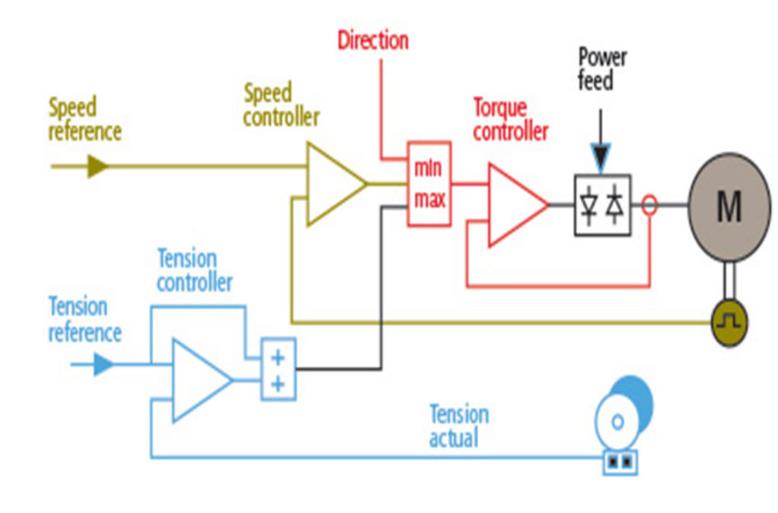
The tension of each unit is controlled at the unwinding portion of each unit, and the analog signal is fed back to the control unit, such as a PLC, via the tension amplifier, in order to precisely control the tension of the material and meet the requirements of the production line for the production process.
Composition Of Web Tension Control System
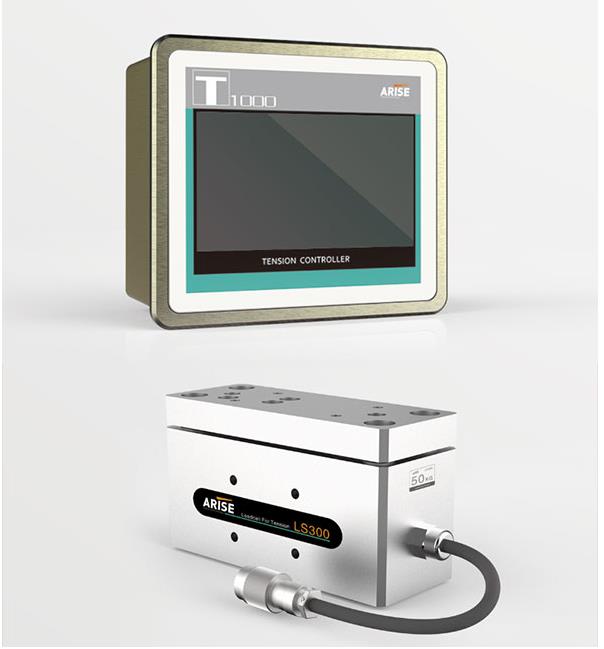
The web tension control system can be used to create tension signal amplifiers, tension display meters, and tension controller, among other things. Standard flange and housing mounting are two installation methods.
Web Tension Detector
It is used to detect the tension of coil material in real-time. It is built with a metal foil strain gauge and a wheatstone full bridge design. It has high detection precision, good linearity, high repeatability, little hysteresis, and a high overload coefficient.
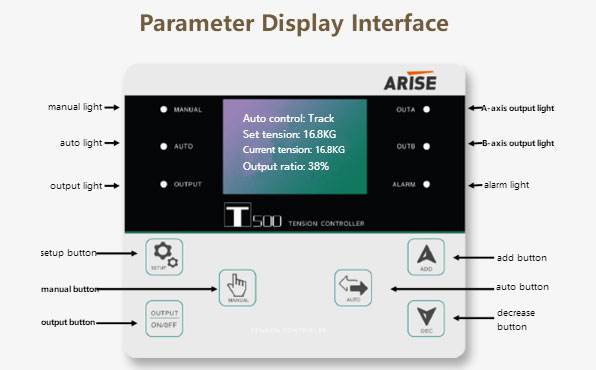
Web Tension Controller
Web tension controller adopts the PID calculation output to various types of actuators including AC and DC motors, pneumatic brakes / clutches, magnetic powder brake clutches for tension control, the tension detection signal, the floating roller signal, the winding diameter position signal, and other signals.
Why Choose Arise WebTension Control System
Controlling web tension system has numerous applications in various industries. The precision of coil tension control is becoming increasingly precise as automation advances. Arise achieves true constant tension control through a precise detection and control system. In the field of tension control, has rich experience in tension control, and has a full range of tension control products. Its excellent web tension controller, web tension detector, web tension display, web tension signal amplifier, etc. provide customers with perfect solutions.
Many tension control problems on coating machines, printing machines, slitting machines, compound machines, and other models are solved by the Arise tension control system. These issues primarily affect material unwinding, feeding traction, and discharging. The four tensions refer to the four tensions that occur during the traction and winding process: unwinding tension, feed traction tension, discharge tension, and winding tension. All four tensions are fed into variable frequency motors, magnetic powder brakes, servo motors, and so on. To better meet customer needs, the Arise tension control system can also perform high-speed non-stop roll change and new roll pre-drive functions.
Magnetic powder clutch brake is widely used, and it is classified as follows: Brake Control, Start-Up This application includes normal start (clutch) and brake functionality (brake). Because the motor is idling, the maximum torque of the motor can be fully utilized when the load is started. As a result, even if the load GD2 or starting resistance is high, it can be started up easily and smoothly without causing significant impact. Furthermore, because the motor is completely idling, it is extremely beneficial to improve the motor’s working conditions and extend its service life. Furthermore, based on the torque characteristics, adjusting the excitation current is all that is required to control the start and braking time, or to change the start and brake process curves.
Application Of Magnetic Powder Clutch Brake
Large transmission equipment, walking cranes, large blowers, axial fans, air compressors, cement kilns, paper machines, rotary impact machines, rolling, rolling machines, wire drawing machines, large textiles, printing and dyeing, and printing are all practical applications. Machinery, as well as the inching and operation of various pieces of industrial machinery.
Selection Of Magnetic Powder Clutch Brake
1. Torque range of operation The magnetic powder clutch’s maximum torque is affected by coil heating, magnetic saturation characteristics, powder life, and mechanical strength. It is capable of absorbing 130% of the theoretical torque. The lower torque limit is determined by the idling torque and torque stability, with more than 50% of the theoretical torque.
2 . The structure type
A coil-type magnetic powder brake with a slip ring has good heat dissipation but is prone to failure and has low reliability. Furthermore, this structure necessitates frequent reverse operation during operation, which is detrimental to bearing life and unsuitable for high-speed transmission systems. The coil-type magnetic powder clutch operates reliably and has a low idling torque. After energization, the torque increases quickly, but the excitation power, volume, and weight are slightly increased.
3. The cylindrical rotor structure size, magnetic powder is uneven, stable performance, suitable for large machinery; cylindrical rotor moment of inertia and small size, suitable for mechanical transmission requiring high sensitivity The rotor has a low moment of inertia and moves quickly, allowing it to be used in high-frequency combinations.
The web guiding system reduces the possibility of cross-pulling, wrinkling, film rupture, corrugation, and other issues, allowing for high-speed and high-efficiency thin-film production.
Working Principle Of Web Guiding System
The working principle can be reduced to a closed loop control loop: the starting point for automatic correction is to pull the current position of the inlet film by one or more sensors. Scan the film’s current position and send it to the controller. The measured actual position is compared to the set position by the controller. If there is a difference, the controller will send a guiding signal to the driver. In this cycle, the web guiding system always drives the track to reciprocate, preventing material removal and offset from occurring.
Operating Mode Of Web Guiding System
The web guiding mode selected is determined by the customer’s process requirements. The following are the primary guiding modes.
1. Edge guiding: Use a sensor to guide the deviation based on the film’s left or right edge.
2. Center guiding: Two sensors are used to align the offset according to the center line of the material, and can be divided into fixed centering guiding and moving centering correction.
3. Line guiding: Use a sensor to correct the deviation based on a continuous or discontinuous line contrast.
Control Method Of Web Guiding System
The EPC web guiding system has two control modes: automatic control and manual control, which are usually both. During production, the EPC guiding control of all film production lines switches to automatic control mode. The manual control mode is primarily used to test the system’s operation status in order to detect problems in real-time.
The curtain calendar is an important piece of equipment in the tire’s pre-production process. During the calendering process, parameters such as the position and width of the material are extremely important. It is required in key positions such as curtain lining opening, cooling, storage, compounding, and curtain lining.
Application On Small-angle Cutting Machine
The Arise web guiding is primarily used in the small angle cutting machine for material opening and winding. However, depending on the process requirements, the curtain may need to be cut into the same or different widths, so a set must be added before the cutting knife. The centering guide system keeps the material in the center at all times. The PRE CCD type correction system is commonly used here, and the precision can be controlled to within 1 mm.
Application On 90-degree Cutting Machine
Materials must be corrected for material opening, winding, and splicing in the 90-degree cutting machine. The precision of the two materials in the splicing is very high. In general, the PRE employs a master-slave correction system. Using a piece of material as the active material, only the position is not corrected, and the moving material’s position is referenced by the active material, and the following correction is performed, with a correction accuracy of 0.2 mm.
Application On The Molding Machine
Because of the high demands on the composite dimensional accuracy and centering accuracy of the sidewall and inner liner components, a set of centering guides should be installed before the sidewall and inner liner are combined. Infrared centering guiding is commonly used here to ensure the composite size and precision of the two rubber parts. Simultaneously, before the above composite parts are attached to the forming drum, a digital sensor guide system is added to the feeding conveyor to ensure the composite parts’ centering accuracy when they are attached to the forming drum.
Application On Slitting Machine
The slitting and creasing machine is an important part of the corrugated board production line that can significantly reduce cardboard waste. The Arise slitting machine guide system employs a high-precision, wide-width CCD detection probe with a large thrust electric drive, precisely aligning the edge of the paper or printed line, correcting the centering or opposite sides, ensuring accurate and stable cutting, and reducing corrugated paper. The quantity of waste edges.
Arise offers high-precision web guiding system to help industry customers to achieve stable high-speed processes in various machines which widely used in different industries.
In order to carry web material through roll-to-roll conversion machines, a web guiding system is required. Without an automatic web guiding machine, a variety of variables, including process fluctuations in tension and speed, differences in the quality of the material’s properties, poorly maintained machinery, traction changes, and so on, can disrupt the appropriate alignment of the material.
Web Guide Components
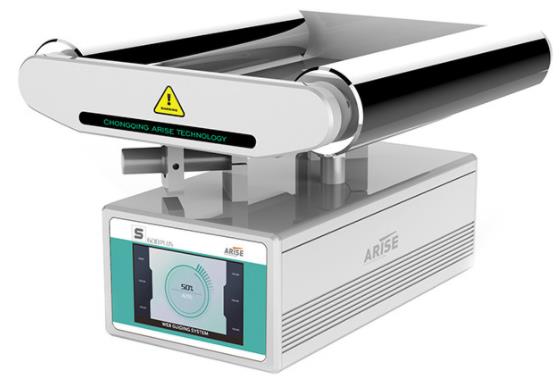
The fundamental parts of a conventional web guiding system are a controller, a position or web edge sensor, an actuator, and a guide mechanism. The mechanical component that makes contact and moves the web material is known as a web guide mechanism. Depending on the machine, the mechanism comes in a variety of shapes and sizes.
As the name suggests, a web edge sensor detects the position of the web as it travels through the web guide mechanism and the sensor’s position is the reference point that the web will be guided to. Web guide controllers are used to manage the web guiding system. The controller uses readings from the sensors to take necessary corrective measures and actions. Once processed, the controller sends a corrective command to the actuator to adjust the guide mechanism to actively control the web position.
What Type of Web Guide Do You Need?
Rolls are telescoped or offset, webs are cambered or baggy, and rollers are deflecting or out of alignment. All of these flaws will contribute to the web’s detour. A little off-tracking is fine, but too much lateral shifting can cause major issues. An automatic web guide system is the perfect solution you need to turn a losing hand into a winning one.
To find right web guiding , there are three easy steps.
1.Determine where lateral position accuracy is required.
2. At each guiding location, decide which web guide will best meet your needs.
3. Install the web guides in each location as directed by the application. Once you’ve decided on the type of guides you’ll use in your process, the next step is to make sure they’re all properly installed.
Four Types Of Web Guide
Web lateral-position control systems are classified into four types: unwind sidelay guide, displacement guide, steering guide, and winder sidelay guide. Three of these are true web-guiding systems (unwind sidelay, displacement, and steering), which redirect the web to the proper lateral position. The final option, winder sidelay, moves the equipment to meet or chase the web rather than guiding it.
The right web guide, set up correctly and in the right place, will give you a winning hand every time for every product. Continue reading to learn how to determine the appropriate based on process location and some rules for configuring each type of guide. But don’t be concerned. You are not required to play all of these cards by yourself.
Unwind Web Guides
Unwind guides are a type of terminal web guide that eliminates the need for pivoting when aligning web material into a converting machine. These web guides, unlike terminal web guides, do not require any pivoting motion. Automatically positioning an unwinding roll of material mounted on a laterally shifting roll stand carriage results in unwind guiding. The stand is equipped with a shifting idler roller. The sensor is fixed and not attached to the stand.
Rewind Web Guides
It is also called shifting rewinds, which are found at the end of roll-to-roll machines, are one of the tools used to ensure that the wound roll is not telescoping. Rewind guiding, also known as “chasing,” controls the edge position of the wound roll by having the shifting stand and attached sensor “chase” any web misalignment as the roll winds to align each new wrap or layer of the wound roll. Between the sensor and the rewinding roll, a fixed idler roller is required.
The third type is known as electrohydraulic, and it employs photoelectric sensing rather than an air signal. The sensor signal is routed through an electrically operated servo valve, and hydraulics is used to position the web-guide structure. WTI’s Tom Herold claims that electromechanical web-guiding systems can handle 95% of all converting applications.
The fourth type is electromechanical, which is the most sophisticated and versatile, but it is also the most expensive. Photocell, ultrasonic, or infrared edge sensors are commonly used in these systems. There is no such thing as a universal sensor; each has advantages and disadvantages, but because there are options, converters can choose the best sensor for specific environments or converting applications. The signals are routed through an amplifier to an electrically operated actuator.
Web guiding system realizes high-speed and high-efficiency production of coil, film materials, choosing the right type of web guide can greatly improve your working efficiency of various machines.
The printing of decorative patterns, patterns, or text on packaging is referred to as printed packaging. A web guiding system is used to automatically guide any type of flexible printing material, regardless of width, load, or seed. They have a wide range of applications for all types of flexible printing, packaging, and converting machines, tracking roller assembly, rotogravure printing machines, lamination machines, Flexo printing machines, coating machines, winding rewinding machines for inkjet printers, are all available. Arise has been providing accurate web guide system for the printing and packaging industries as one of the most professional web guide machine manufacturers.
Advantages of Web Guiding System For Printing Machine
This is a displacement guide system that can quickly correct high-frequency feed errors during the stroke process. Highly compact frame-type rectification with integrated operation and remote control technology, capable of guiding coil position under conditions of minimum inlet and outlet span, with good dynamic response and high execution precision.
1. Three operation modes are supported: edge-following, line-following, and center-alignment.
2. Photoelectric sensor, ultrasonic transducer, and CCD sensor support.
3. Intelligently detect sensor parameters; in most cases, no need to correct the sensor.
4. Control system for printing machines with web guide controller.
5. Automatic travel measurement eliminates the need to mechanically limit the switch.
6. No overshot integral variable PI algorithm, high accuracy, quick response, and low error.
7 Analog quantity transducer signal, 12bit AD sampling, 700000 times per second.
8. A DC servo motor is used to move the ball screw.
9. Power-down memory of all system parameters at any state.
10. Save 10 groups of parameters from different materials for easy and efficient material switching.
11. Support Modbus and PLC/Human-computer networking control.
Why Choose Arise Web Guiding System For Printing Machine
Arise is dedicated to the design and development of a truly innovative and practical coil rectification control system for the continuous and precise control of various production processes in the printing and packaging materials manufacturing process. Strip material types reduce waste and downtime, ensuring that the machine functions properly, lowering production costs, and improving product quality and productivity.
Arise is the culmination of advanced technology that provides stable, accurate corrective performance via a simple, user-friendly interface. The system’s functions are precisely controlled by microcomputer digital and touch controllers. The all-in-one web guiding machine provides several detection methods, including edge guide, line guide, and center/alignment guide. Depending on the materials tested, various sensors such as ultrasonic, infrared, and photoelectric can be used. The drive system is driven by a servo motor, and the drive stroke is strictly proportional to the offset of the coil, ensuring faster and more accurate response of the entire system.
In the printing and packaging industries, the Arise web tension controller has a wide range of applications. The precision of coil tension control is becoming increasingly precise as automation advances. Arise achieves true constant tension control through a precise detection and control system.
The web guide control system is intended to solve the problem of material deviation or equipment deviation. The coil’s position is always tracked and corrected in real time during the manufacturing process. Without manual intervention, production can be ensured and improved.
Web Guide Control System Composition
A web guiding controller, a web guide sensor and a guide frame comprise the web guide control system.
Web Guide Controller
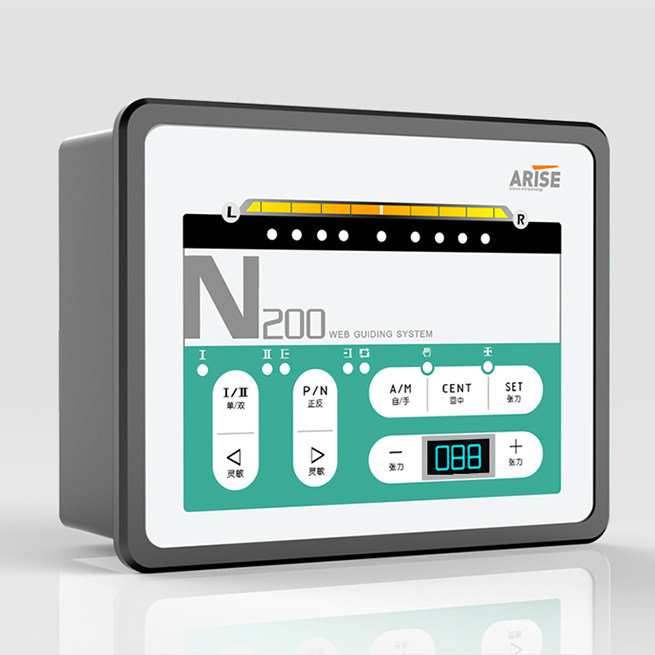
The core component of the guiding system is the web guide controller. The Arise web guide controller is simple to use, elegant in appearance and has a high level of system accuracy.
Web Guide Sensor
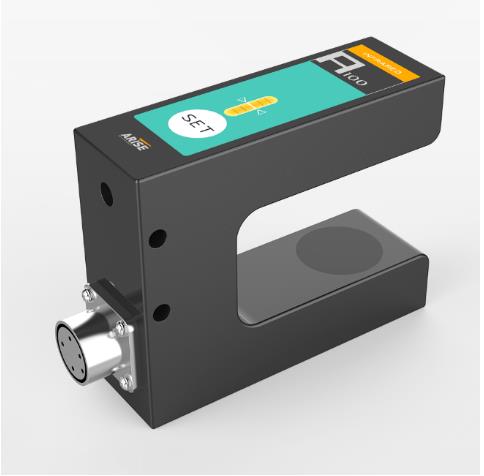
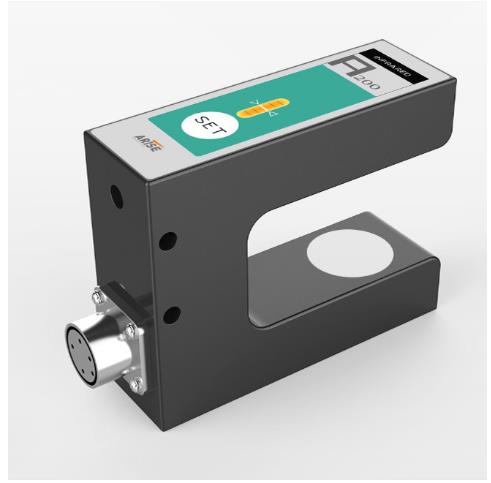
Arise web guide sensor has the advantages of high precision, fast reaction time, and a wide range of materials.
Web Guide framework
Arise web guiding frame can meet the needs of various product production lines in the industry. It has the benefits of easy installation, simple operation, and a good appearance.
Classification Of Web Guide Control System
The power equipment of the EPC web guiding system is classified into four types: electromechanical, electrohydraulic, pneumatic, and magnetic. The following figure depicts the structural principle of the electro-hydraulic EPC web guide system.
The magnetic web guiding system is still in the experimental stage, with Bruckner, Germany, being the primary user. In China, there is still no relevant information. At the moment, the two types of biaxially stretched plastic film production lines are widely used both at home and abroad.
The sensors in the three control systems are similar in structure, including infrared sensors, reflective infrared sensors, ultrasonic sensors, digital sensors, pneumatic sensors, laser sensors, and camera sensors, which include electromechanical and electrohydraulic sensors. It is primarily used in infrared and ultrasonic sensors.
Electromechanical and electrohydraulic web guiding systems are also equipped with a powerful and easy-to-use controller. When the film is produced at high speeds, it has a high dynamic response level and detection accuracy. It can be remotely and in real time monitored. control.
Wide Applications Of Web Guide Control System
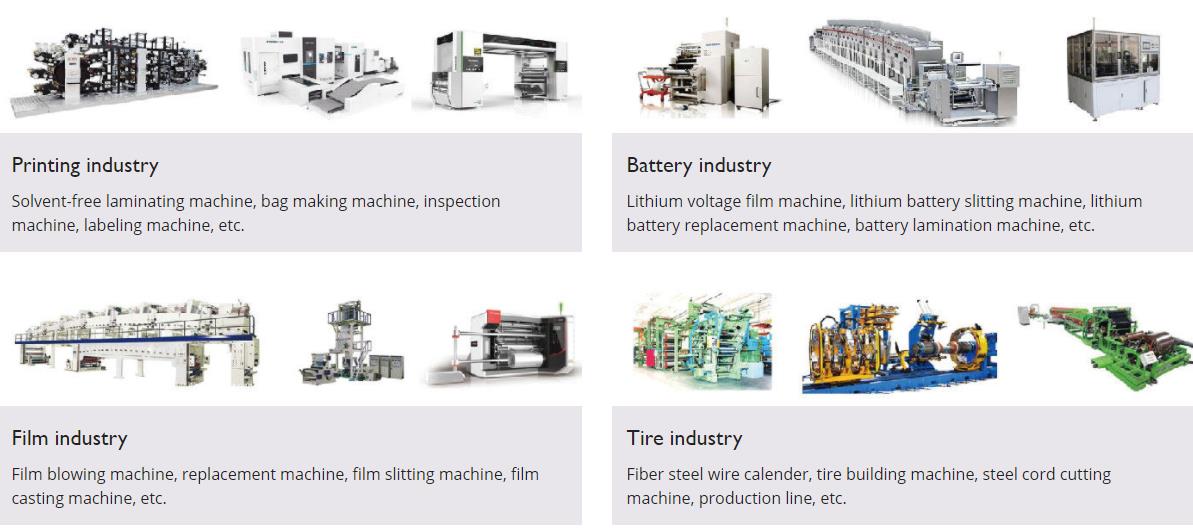
Tire, Rubber Industry
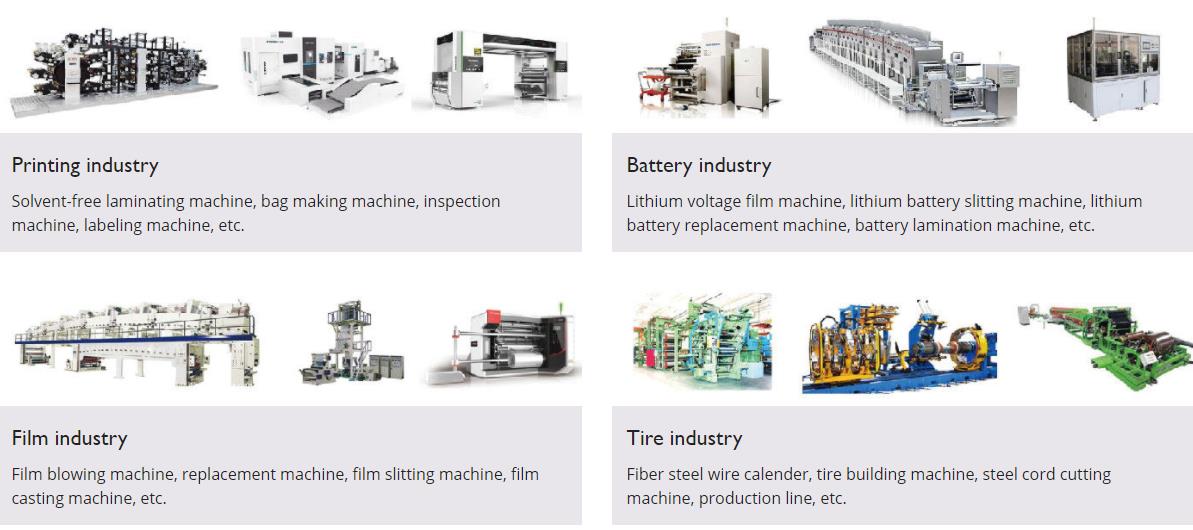
The ultimate goal of the web guide system in the tire industry is to guide the material offset and ensure that the material is in the proper position to meet the needs of the production process. The rectification control system can be used on a variety of machines, including extrusion linkage, inner liner/film roll, curtain calender, cutting machine, and molding machine, but the specific methods and applications vary by machine.
Lithium and New Energy Industry
In the lithium-ion coating and slitting industry, the pole piece appears to be deviated in the continuous rolling production line of the battery pole piece due to mechanical errors in the unit, deviation of the guide rod, vibration, and fluctuation of the pole piece tension. It makes the pole piece vulnerable to damage during the rolling process, compromising product quality and economic benefits, and the tower type roll phenomenon frequently occurs during the winding process.
Arise guide system effectively overcomes these issues and is at the forefront of the industry. The sensor detects the offset of the material. After comparing the operation, the controller sends the action command to the driver in a very short time, ensuring that the material can run along the specified line in the mechanical work, and the correction accuracy can reach 0.1mm, fully meeting the customer’s accuracy requirements.
Hygiene Products Industry
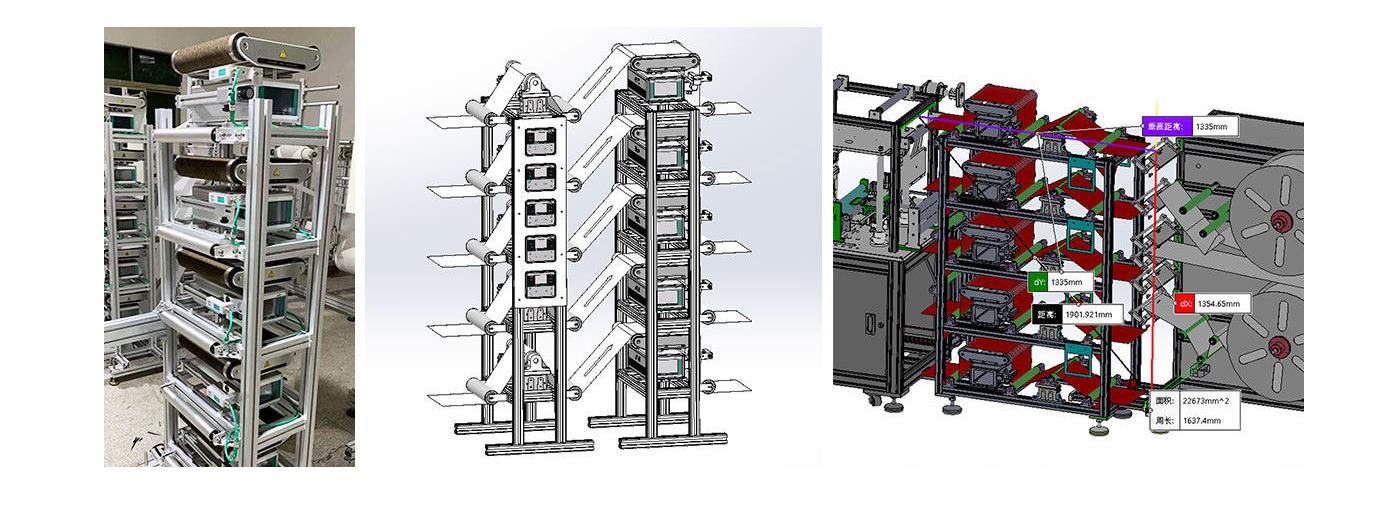
Arise is dedicated to providing complete solutions for the sanitary products industry. Its main products, which include sanitary napkins, baby pants, pants, pet mats, and so on, are widely used in sanitary napkins, baby pants, pants, and so on. It has been well received by users and is at the forefront of the market with high cost performance on the production equipment, and with its exquisite appearance, simple operation, and humanized service. To meet the high-speed production requirements of sanitary equipment, the number of web guides has increased, becoming an important component of sanitary equipment.
Bidirectional Stretching Equipment
The use of a web guiding control system in the production line of biaxially stretched plastic film is undeniably successful. It greatly reduces the likelihood of problems such as cross-clip, wrinkle, film rupture, and ripple jitter occurring, and it enables high-speed and high-efficiency film production.
As a leading web guide control system manufacturer, Arise is committed to providing a perfect solution, which includes web guiding equipment, web tension controller, and web guide sensor, which have been widely used in various industries.
What should you consider when selecting screws for your next project? This the question is that technicians who assemble various products ask themselves when trying to find an ideal kind of custom screw for their work. Screw fasteners are distributed to different industries from automotive, construction, and transportation to medical, mining, and furniture industries, custom screw options continue to revolutionize the fastening market.
Advantages of choosing custom screw
Made-to-Order
The availability of a variety of custom screw options offers an endless list of possibilities for product designs. You can now order your fasteners with the preferred shape, head-size, length, and even threading size. Understanding these primary features allows development engineers to come up with better quality products for their companies.
Mechanical Advantages
The right customized fastener offers benefits on tailored installation torque required. Torque refers to the forces that move the screw and rotates it. Customizable fastener options allow the product developers to use the right amount of torque during the product fastening. This way, you can avoid breaks and loosening of other parts during assembly. Custom SEMS screws come with built-in washers to secure the screw in place, increasing product safety.
Resistance to Rust
Fasteners are subject to corrosion and loosening through wear and tear. Proper finish coatings of custom screws help to keep the screws resistant to corrosion. The advantage of custom screw options is that you choose the proper coating for your product. Chrome and zinc coatings are standard in the micro screw industry. The layers offer ideal polished finishes that have improved resistance to wear in, especially in tough environments.
Strength
Custom screw options come in different shapes and sizes, and in most cases, this determines their strength. A fastener is only useful if it can hold the screwed products firmly without bending or breaking. Customizable options provide an opportunity for you as a manufacturer to select the right threading and thickness of the screws. You can also select the correct thread depth for maximum robustness and minimized radial stress.
Safety Standards
The right machine screw assures improved security and performance for your products. Since 1927, the American National Standards Institute has provided manufacturing grades for all fasteners. The set quality ensures that the quality of the custom screws is not compromised, which in turn guarantees better product quality.
Right Materials
The use of custom screw options provides an opportunity to select the best materials depending on your products. Approximately 90% of all custom micro screws are made of stainless steel. Stainless steel has better tensile strength and is more durable than many other materials. You may also use bronze and brass alloys with increased resistance to corrosion. Aluminum is lightweight and customized for lighter machine parts and devices.
Various types of materials used in the making of custom screws.
Here are the material characteristics that you should consider to improve your custom screw sourcing
The material’s ability to resist corrosion
When choosing materials for screws, you should consider whether the screws environment will be corrosive. Materials with high corrosion resistance such as steel are ideal for micro screws that will likely get exposed to corrosive conditions.
Mechanical properties of the material
Some metals are brittle and easy to bend and scratch. When such metals get used in making screws, it becomes hard to screw or unscrew some tight miniature screws. As such, you should look at the specific alloy strength of a material to determine whether the material can bear with various damaging forces.
Aesthetics
Aesthetics is the least important factor when compared to screw strength and durability. But it’s also essential where screws get used on prominent decorative pieces or devices. For example, a copper custom screw or copper-plated screw may have a better appearance when used on a prominent place than would be the case for a steel custom screw used in the same place.
Operations of screw fabrication
When choosing a material to make a screw, you should also look at the material’s ability to get processed with ease. Things to look at should include the strength of the material to be cold-headed, welded, or machined.
The cost of the screw material
The value of the metallic alloy to make the micro screws gets determined by considering factors such as the effective life-expectancy of the finished screws, the installed price, and the initial alloy cost. When materials match in strength, durability, fabrication needs, and mechanical properties, then cost, and aesthetics become the second-last considerations to make.
The availability of the material
The availability of the material is the last consideration to make. No matter how good a material is in making micro screws, if you can’t find the material in enough quantities, then you’re less likely to choose such material for your micro screw fabrication.
The Most Preferred Screw Material in the Making of a Custom Screw
Stainless steel material for fastener is the most affordable and abundant. It is a versatile material that you can combine with other metals to create durable alloys. Minerals that you can use to make steel alloys include silicon, cobalt, tungsten, copper, molybdenum, nickel, chromium, and manganese. It is hard, malleable, and durable.
Your custom screw material options are extensive. Make careful considerations when selecting material for your screws.
Screws are one of the most important tools you’ll ever use. They’re used everywhere. Screws hold your doorknob in place, they keep your lamps together, and they’re actually used in probably every electronic device you own. Complicated electronic devices are held together with small screws. It takes a miniature screw to hold essential components together, and it takes a miniature screw manufacturer to make it all happen.
Screws are so much a part of daily life, it feels as though they’ve been around forever. You probably have a drawer with some loose screws rolling around in it. Today, screws come in all shapes, from tiny screws to custom screws. You can get a stainless steel screw and you can even find experts who can build a custom screw for you to use. But it’s the miniature screw that you probably rely on the most, and you don’t even know it.
Miniature screws aren’t just used in the tech industry. Micro screws, or miniature screws, are used in all sorts of manufacturing and building. Even a miniature screw gets the job done and holds pieces together securely. Thanks to miniature screws, designers and engineers have the ability o design small, complicated devices and products. The miniature screw allows creative people to really stretch their imaginations and design new, never-before-seen devices and products. They don’t have to worry about designing things that are big enough to be screwed together. Thanks to the miniature screw, they can think outside the box and create amazing new designs. Smartphones and other small devices wouldn’t be possible with micro screws and other small fastener options like the miniature screw.
It takes miniature screws to hold the delicate, tiny components of electronic devices together. If you’ve ever taken a smartphone or a laptop apart for any reason, then you’ve seen a miniature screw or two. You may have even struggled to loosen one of these undersized screws. Small screws are essential in the tech industry because all those little pieces of complicated devices have to be put together and stay held together. A miniature screw is the perfect answer.
Key advantages of miniature screws
Easier to remove.
Miniature screws are strong and hold fast to the items and materials you’re piecing together. But they’re also easy to take out when you’re looking to replace a part or move the screw somewhere else because they require less force for installation. This is key for fast and efficient work.
Save money on materials.
When you remove a screw from your project, there’s a chance the screw can become damaged. This is usually the case if the screw was difficult to install. Regularly replacing damaged screws can be costly. Fortunately, you don’t have to worry about that with miniature screws. Because micro screws can be easily installed and removed, there’s less risk of damaging the screw. That means they can be easily reused if needed.
Faster production times.
Tools that keep you from working efficiently are tools that cost you money. Micro screws are easy to install and remove, which makes for easier and more efficient production. The result? Saved time and money. Plenty of variety. Miniature screws have all the variety of regular-sized screws. No matter what your project needs, you can find the diameter, thread pitch, and thread length that works for you.
Less waste.
Not only are you saving money on materials when you use micro screws, but you’re also reducing the amount of waste you or your business is creating. This is great for the environment and for your company brand. It also means you’ll need to make fewer trips to the recycling center every month to recycle your screws and other steel materials, which also helps to save valuable time.
Miniature Screw Suppliers
The miniature screw is small and easy to miss because of its size, but it’s also something that makes so many other things possible. Many product designs and device styles are suddenly possible simply through the existence of the miniature screw. Suppliers who create small screw and custom screw options are actually behind it all. It’s these manufacturers to enable the engineering and designers to get creative. It’s because of the miniature screw that so many things are possible.
KENENG is the screw manufacturer you can trust for high-quality undersized screws and custom screw options. It provides engineers with custom fastener options, miniature screws, and other types of micro fasteners. When the screws are customizable, the designers no longer have limits on what they can create and the devices they can actually make. KENENG can make miniature screw designs in ultra thin head styles with incredibly precise design.
Fasteners are used annually in different manufacturing industries such as automotive, construction, transportation, mining, and heavy equipment. Custom fasteners are a vital tool in the assembly process as they are used to fasten screws bolts and nuts that keep different parts of a product intact.
Right amount of torque on the bolts and nuts
Getting the right amount of torque on the bolts and nuts of a product, say a car, is very crucial, as it adds to the overall safety and quality. When manufacturers are selling their products, they need to make sure that the right value of torque is applied to the bolts and nuts when they are clamping different parts together.
Torque is the twisting force that causes the bolts and screws to rotate and is measured by force applied on the custom fasteners, multiplied by the length of the fastener. Achieving the correct torque is essential to the assembly of any machine that utilizes screws and bolts. When using custom fasteners, it is important not to over-tighten the bolts by applying excess torque as this will make them loose in the long run, or cause them to crack. You should also not apply too little torque to the bolts and screws as they become loose and fall off.
Today, manufacturers have more fastener options such as torque wrenches, micro fasteners, and captive fasteners. Additionally, screw manufacturers have also added to the screw options by improving captive screws, micro screws, and miniature screws. Matching these different screws to their customized fasteners makes the assembly process for different engineering products more effective, as it is easy to tell the right amount of torque required.
Reasons why you should use the right amount of torque for bolts, screws, and nuts.
1. Preserves the Quality of Bolts, Nuts, and Fasteners
When you use excess torque when fastening bolts and nuts, you run the risk of stretching, bending, or even cracking the bolt. As you apply more torque force than required, you overstress the bolt, and this makes it lose grip and fall off. Resultantly, the bolt or nut is rendered useless and cannot be used on any other part. Considering you have a long line of assembly, using the wrong custom fasteners will result in massive losses.
Additionally, excess torque force also damages the fasteners. If, for instance, you habitually use the wrong torque wrench and apply excessive force when tightening a bolt, the wrench will also lose its grip because of the excessive friction produced.
2. Enhances security and performance
For instance, if you manufacture cars, you need to ensure that all the bolts and nuts for the wheels, engines, and other body parts are properly fitted. Especially for fast-speed cars, you must ensure that the wheels are fitted with the right bolts and nuts and that the right amount of torque is applied when fastening them. The last thing you want is a bolt spinning off while the car is at high speed, as this would result in a catastrophic accident.
Ultimately, if any of your products have parts that are clamped together with screws, bolts, and nuts, you need to invest in custom fasteners so that you can avoid applying excessive or insufficient torque. However, keeping tabs on the different fastener and screw options may prove to be overwhelming. Luckily, you can seek professional help from screw specialists near you so that you get maximum utility from custom fasteners, screws, bolts, and nuts.
Why choosing stainless steel is your fastener raw material
Stainless Steel is a Soft Metal
Stainless steel material is considered a soft metal, and as such isn’t recommended for high load uses that require a great deal of strength. However, because stainless steel screws and fasteners are available in different grades, it is possible to find stainless steel options that are stronger. Grade 410 stainless steel, for example, is a variation that offers a higher strength yield.
Corrosion
While stainless steel screws and fasteners are highly corrosion-resistant, they can still corrode under the right circumstances. Stainless steel grades, 305 and 304 are examples that have a variety of their own benefits, but when exposed to high levels of salt and humidity can still experience corrosion over time. For applications near beach-like conditions, grade 316 is recommended.
Non-Magnetic
Stainless steel is not magnetic and as such is not a good candidate where magnetism is needed. However, if the goal is to create something with no magnetic pull or interference, stainless still is something to consider.
Self Repairing Layer
Stainless steel screw and fastener options have an oxide coating that helps protect from external environmental factors. This is one of the main contributing factors that makes it so good at withstanding corrosion. As long as the steel is in an environment rich in oxygen, any damage to the metal will cause the oxide layer to begin to reform and re-protect the damaged area.
Reactions with Aluminium
Stainless steel and aluminum don’t get along. Because one is positively charged and the other negatively charged, these metals, if introduced with an electrode — such as saltwater — galvanic corrosion will occur and ruin the integrity of the materials. To avoid this happening, utilize a barrier between the two materials or simply forgo the use of one entirely.
Stainless steel can be an excellent option for custom screws and fasteners, but only if you fully understand the limitations and conditions in which it will be used. If you are looking for the best custom screws and custom fasteners, reach out to a manufacturer and discuss your options. They will be able to help you decide if stainless steel is the best option for you.
The screw, nuts, and bolt markets have seen a lot of changes in the kinds of products that consumers buy. Over the years, fastener manufacturers have been coming up with unique customized products. Why is this happening? Because they know that consumers have different needs and they want unique screws to fulfill those needs.
Which thread-locking mechanism is ideal for your micro fasteners? Is copper or steel a perfect option for your custom screw options? These are some of the questions that most product assembly technicians ask when looking for fastener options. The global market of micro fasteners is massive, but how can you get the best of what you’re seeking?
This post highlights some of the essential factors that you’ll need to consider when buying micro fasteners for your assembly project. Understanding the primary features of the micro screws that you seek will better and quicken your sourcing process.
For example, custom manufactured micro screws come in different sizes and shapes to meet the various needs of consumers. If you have been looking for the best fastening solutions, you may want to check out the various products that reputable suppliers can offer. But how can you determine whether the supplier is trustworthy or that the products they carry will align with your requirements? Here is a look at some of the factors to consider when looking for the best supplier.
Look For Screws with Washers
When you want to build a custom fastener, you should think of ways to make the screws stronger. One of the best ways of doing so is by using washers. You will notice that although some fasteners come with one washer, others come with several because some machines may need a stronger bond than others. Therefore, before you buy custom screws, ask the supplier about the number of washers that they come with and to what extent they will make your machines stronger.
What’s the Coating Material of Your Micro Screws?
Corrosion quickens the wear of micro fasteners and makes the fastened components loose. But with a proper coating, your micro screws experience less wear and tear. Some linings also make your screws more appealing, and this is ideal for decorative miniature screws.
You may choose to buy chrome-plated or zinc plated screws. Chrome-plated screws have a corrosion-resistant and decorative polished finish. These screws are ideal for components that need high-quality polished finishes. The zinc-plated micro fasteners have improved resistance to corrosion under most environments.
Ask For Screws with Locking Patches
Custom manufactured micro screws are likely to be of better quality when they come with locking pieces. Most manufacturers use nylon threads to coat the external and internal threads. When the coat is applied, it creates a self-locking mechanism on the screws, and this makes them fasten better. Custom fasteners are made using different threads based on the kinds of situations under which they will be used. You may want to talk to the supplier to find out what they can do based on your needs.
Which Material is Ideal for Your Micro Fasteners?
The material that makes up micro screws determines the micro fasteners’ cost, brittleness, strength, and corrosion resistance. Approximately 90% of the micro screws in the market are manufactured from stainless steel. Steel is a preferred material for micro screws because it has a high degree of formability, durability, and strength.
Bronze and brass alloys have considerable corrosion resistance, which makes them ideal for marine engineering. But bronze is expensive, and that is why it’s used in marine works. Aluminum is also a common material used in making corrosion-resistant micro screws. Aluminum is also light-weight and ideal for parts that shouldn’t get heavy.
What’s the Size of Your Preferred Micro Screws?
Screws differ in size, which is a conventional screw differentiating factor for these micro fasteners. Manufacturers of screws make capabilities in specific screw size ranges such as the M5 and smaller or M6 and larger screw sizes.
Inquire About the Screws Suited to Your Size Specifications
Manufacturing screws to the correct value is another crucial factor to consider when buying custom-manufactured micro screws. Sometimes, you will notice that fasteners are too small or too big. When they are big, it means that you will have to use a lot of force to fix them. The result is that they will be prone to breakage. On the other hand, screws that are too small are likely to be weak no matter how much you fix them. It is for these reasons that you should talk to the supplier so that they understand the correct values for your needs. The best suppliers have several custom screw options.
What Screw Features Do You Want?
There are many kinds of industrial micro fasteners in the market with diverse applications. For instance, different types of screws may have different heads, sizes, threading, and thread-locking mechanisms. Each type of head and thread-locking method determines the kind of purpose your screw will serve.
As such, you have to choose your micro screws based on their different physical features. You may also opt to customize your micro fasteners to suit your unique needs. Custom screws are ideal when off-the-shelf options can’t fulfill your needs.
Search For a Variety of Plastic Thread Forming Screws
If you want custom manufactured micro screws to have more holding power, you should look for a variety of thread forming screws. You should ensure that you have several fastener options because different types of screws need different types of fastening options. When using the fasteners, you will notice that some of them are easier to drive, but others are not because there is a difference in the size of threads. It is good to ask the suppliers for narrow or broader threads based on what you want to do with the fasteners.
What’s Your Micro Fastener Source?
You can source your tiny screws from a screw manufacturer or a screw distributor. The latter is often the preferred option when looking for diversified types of screws and large volume orders. But when looking for a wider variety of fasteners in the low volume range, then it is advisable to buy from a distributor.
Unlike manufacturers who may fail to give quotes on small volumes of micro screws, your distributor can provide quotes for any quantity of screws. Sourcing from a distributor is also beneficial when you’re looking for screws from different manufacturers.
Identify the Best Manufacturers and Suppliers
Identifying the right screw supplier involves looking at the kinds of customers that use their services. For instance, the best manufacturers are those that have a broad customer base. If they are supplying to some of the largest custom manufacturers, you can count on them to provide enough screws. Imagine a situation where you need 100 piece packages of screws. In such a case, you will be looking for suppliers with the capacity to deliver large quantities.







 China manufacturers