Boat navigation lights play a critical role in marine safety, especially when vessels operate at night, in fog, during heavy rain, or in other conditions with limited visibility. These lights help boat operators identify other vessels, understand their direction of travel, and determine whether they are approaching, crossing, or moving away from one another. When navigation lights are damaged, incorrectly installed, poorly maintained, or used improperly, the risk of collisions and other boating accidents can increase significantly.
Understanding how to prevent accidents caused by boat navigation lights is essential for recreational boat owners, commercial vessel operators, and marine safety professionals. By selecting suitable lights, installing them correctly, performing regular inspections, and following navigation rules, boat operators can improve visibility and reduce the likelihood of dangerous situations on the water.
Understanding the Role of Boat Navigation Lights in Marine Safety
Boat navigation lights are designed to communicate a vessel’s position, direction, and operational status to other boats. Common marine navigation lights include red and green sidelights, white masthead lights, sternlights, and all-round white lights. Each light has a specific purpose and must be displayed according to the applicable navigation regulations.
Red sidelights generally indicate the port, or left, side of a vessel, while green sidelights indicate the starboard, or right, side. White lights help other operators identify a vessel’s position and orientation from different directions. By recognizing these signals, boat operators can make better decisions about maintaining a safe course and avoiding collisions.
When navigation lights are missing, incorrectly positioned, or difficult to see, other vessels may misinterpret the boat’s movement. For example, a damaged green sidelight could make it harder for another operator to determine which side of the vessel is approaching. Such confusion can lead to incorrect maneuvering decisions, particularly in crowded waterways.
Properly functioning navigation lights are therefore an essential part of a vessel’s overall safety system.
Common Navigation Light Problems That Cause Boating Accidents
Several navigation light problems can increase the risk of accidents. Identifying these issues early helps boat owners take preventive action before they become serious hazards.
Incorrect Navigation Light Installation
Improper installation is one of the most important issues to address. Navigation lights must be mounted in the correct positions, at appropriate heights, and with the required visibility arcs. If a sidelight is installed on the wrong side or a sternlight is obstructed by equipment, other vessels may receive misleading information about the boat’s orientation.
Lights that are mounted too low may be blocked by passengers, railings, fishing equipment, or other structures. Lights positioned too close to one another may also create confusion if their beams overlap.
To reduce these risks, boat owners should follow the manufacturer’s installation instructions and the applicable requirements of the International Regulations for Preventing Collisions at Sea (COLREGs) or relevant local regulations.
Burned-Out or Damaged Navigation Lights
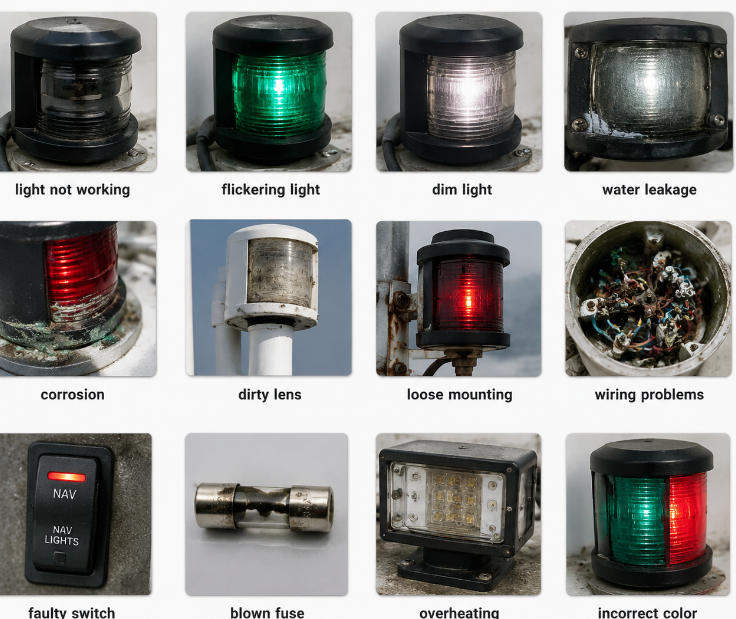
A burned-out bulb, broken lens, corroded connector, or damaged wiring can prevent a navigation light from working properly. Even when a light appears functional during the day, it may fail after the vessel begins operating at night.
Water intrusion is another common cause of failure, especially in marine environments where equipment is constantly exposed to moisture, salt spray, vibration, and temperature changes. Corrosion can weaken electrical connections and cause intermittent lighting problems.
Boat operators should inspect all navigation lights before departure and replace damaged components promptly. Using marine-rated lighting equipment with suitable water resistance and corrosion protection can also improve reliability.
Insufficient Brightness and Visibility
Navigation lights must be visible at the distances required by the vessel’s applicable regulations. Lights that are too dim, poorly maintained, or unsuitable for the vessel may not provide adequate warning to other operators.
Dirty lenses, faded covers, salt deposits, and condensation can reduce light output. In addition, installing a light with an unsuitable beam angle may create dark areas where the vessel becomes difficult to identify.
Choose navigation lights that meet the applicable performance requirements for the vessel’s size and type. Regularly clean the lenses and replace aging or damaged equipment to maintain clear visibility.
Glare and Improper Light Color
Excessive glare can interfere with a boat operator’s night vision. Bright deck lights, searchlights, cabin lights, or incorrectly configured LED fixtures may make it harder to distinguish the navigation lights of nearby vessels.
Incorrect light colors can create another hazard. For example, replacing a red sidelight with a white light may cause other boat operators to misinterpret the vessel’s direction.
Use the correct navigation light colors and configurations, and avoid unnecessary lighting that could obscure navigation signals or impair the vision of nearby operators.
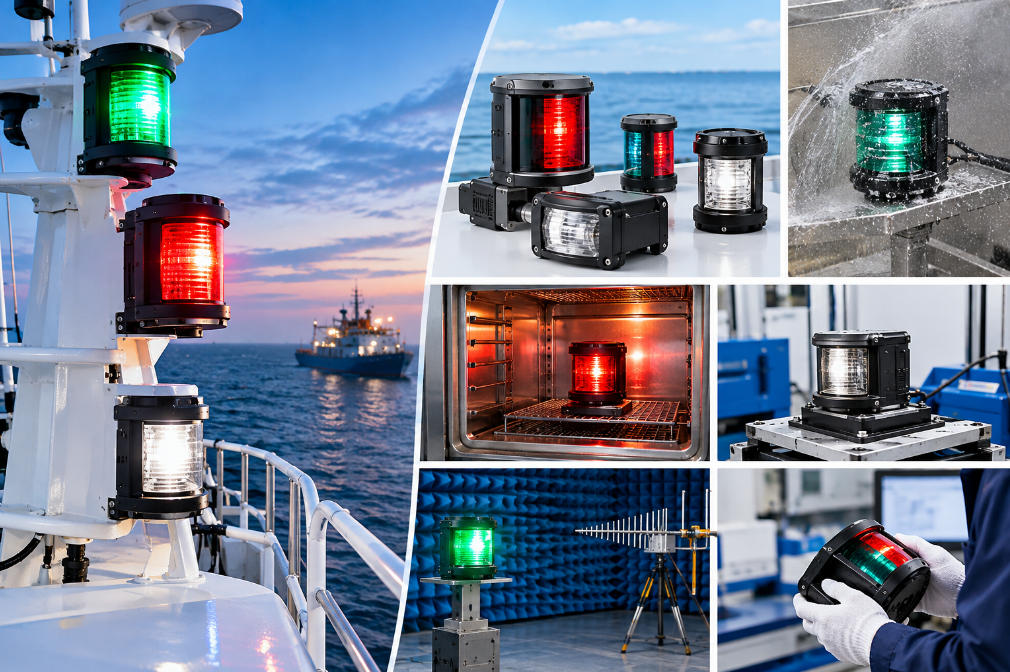
How to Prevent Accidents Through Proper Navigation Light Installation
Correct installation helps ensure that navigation lights communicate accurate information to other vessels. Before installing a new lighting system, boat owners should identify the vessel’s applicable requirements based on its length, type, and operating environment.
First, verify the required number and type of lights. Different vessels may require different configurations depending on their size, propulsion system, and operating status. Recreational powerboats, sailing vessels, fishing boats, and commercial vessels should not automatically use the same arrangement.
Next, mount each light in its designated position. Sidelights should clearly identify the port and starboard sides, while sternlights should provide the required visibility from behind. Masthead and all-round white lights must also be positioned according to the applicable rules.
It is equally important to prevent physical obstructions. Antennas, radar equipment, canopies, cargo, and other structures should not block the required visibility arcs. After installation, test the complete lighting system from different viewing angles to identify dark zones, overlapping signals, or excessive glare.
For vessels operating in regulated commercial environments, professional installation and compliance inspections can help confirm that the system meets the relevant standards.
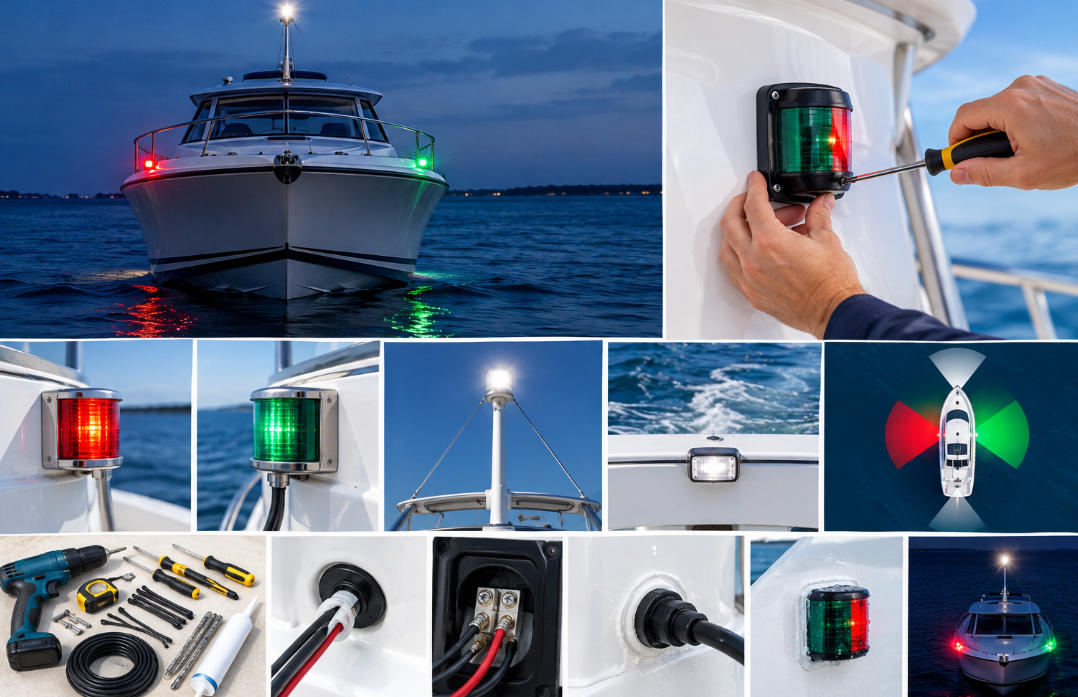
Perform Regular Navigation Light Inspections
Routine maintenance is one of the most effective ways to prevent lighting-related accidents. A simple inspection before departure can reveal problems that might otherwise remain unnoticed until visibility becomes poor.
Before every trip, check that all required navigation lights illuminate correctly. Confirm that red, green, and white lights display the proper colors and that no light flickers or switches off when the vessel vibrates.
Inspect the lenses for cracks, discoloration, dirt, and moisture. Check mounting brackets and fasteners to ensure that the lights remain securely positioned, even in rough water. Examine accessible wiring and connectors for corrosion, loose connections, damaged insulation, and other signs of deterioration.
Battery condition should also be considered. Weak batteries or unreliable electrical systems can cause lights to dim or fail, particularly on smaller recreational boats.
Keep spare bulbs, fuses, and basic electrical supplies on board when appropriate for the installed system. For sealed LED navigation lights, repair or replace the unit according to the manufacturer’s instructions rather than attempting an unsuitable repair.
Most importantly, do not wait for a scheduled maintenance interval if a fault appears. Any navigation light that is not functioning correctly should be addressed before the vessel enters conditions where the light is required.
Choose Reliable Marine Navigation Lights
Selecting appropriate equipment can significantly reduce the likelihood of navigation light failures. Marine lighting products should be designed to withstand vibration, moisture, saltwater exposure, and changing weather conditions.
LED navigation lights are widely used because they generally consume less power, have a long service life, and require less frequent bulb replacement than many traditional lighting options. However, LED technology alone does not guarantee safety. The complete fixture must provide the required color, visibility, beam distribution, and regulatory compliance.
When choosing boat navigation lights, consider the following factors.
Regulatory compliance: Select products that meet the applicable marine navigation requirements. Depending on the vessel and jurisdiction, relevant requirements may include COLREGs, U.S. Coast Guard rules, or other national standards.
Visibility range: Confirm that the lights provide the required visibility range for the vessel’s category and length.
Water and corrosion resistance: Marine-rated construction helps protect electrical components from rain, splashing water, and salt exposure.
Electrical compatibility: Verify that the operating voltage and power requirements match the vessel’s electrical system.
Durability: Look for robust housings, secure mounting arrangements, and materials suitable for long-term marine use.
Manufacturer documentation: Review installation instructions, certification information, maintenance guidance, and replacement recommendations before purchasing.
Reliable equipment reduces avoidable failures, but it must still be installed, operated, and maintained correctly.
Operate Boats Safely in Poor Visibility
Even perfectly functioning navigation lights cannot eliminate every boating hazard. Fog, heavy rain, darkness, rough water, and high traffic can make it difficult to identify vessels and estimate distances.
Boat operators should reduce speed when visibility deteriorates and maintain a proper lookout using sight, hearing, and all available appropriate means. Navigation lights should be switched on whenever required by the applicable rules, including during periods of restricted visibility and other circumstances specified by the regulations.
Operators should also understand how to interpret the lights of other vessels. Recognizing red and green sidelights, white masthead lights, and sternlights can help them assess relative direction and determine an appropriate response.
However, navigation lights should never be treated as a substitute for radar, visual observation, safe speed, or compliance with collision-avoidance rules. Operators must account for the possibility that another vessel has defective lights or is displaying them incorrectly.
When visibility becomes too poor for safe navigation, slowing down, changing course where appropriate, or seeking a safe place to wait may be necessary.
Avoid Common Mistakes When Using Boat Navigation Lights
Several seemingly minor mistakes can undermine marine safety.
One common mistake is assuming that navigation lights are working because they functioned during the previous trip. Electrical failures, loose connections, and damaged bulbs can occur between outings. Testing the system before departure helps identify these issues.
Another mistake is using decorative or general-purpose lighting as a substitute for approved navigation lights. Deck lights and underwater lights may improve convenience or appearance, but they do not necessarily meet the requirements for navigation signals.
Some operators also install aftermarket LED lights without checking whether the fixture is suitable for their vessel or compliant with applicable regulations. A light that appears bright may still have the wrong beam pattern, color, or visibility range.
Finally, boat owners sometimes overlook the effects of modifications. Adding a canopy, radar equipment, a fishing platform, or other structures can obstruct existing lights. Every significant modification should be checked to ensure that the navigation lighting system remains effective.
Avoiding these mistakes helps preserve the clarity and reliability of vessel signals.
What to Do If Navigation Lights Fail While Boating
A navigation light failure during a trip can create a dangerous situation, especially after sunset or in restricted visibility. Boat operators should respond promptly rather than continuing as if nothing has changed.
First, assess the conditions and determine whether the vessel can continue operating safely. If a required navigation light fails, reduce speed as appropriate, maintain a careful lookout, and avoid maneuvers that could create additional risk.
If conditions permit, move to a safe location and repair the problem. Check the relevant fuse, battery supply, wiring connections, and lighting fixture, provided that doing so does not distract the operator or compromise safety.
If the required lights cannot be restored, do not continue normal navigation at night or in restricted visibility when doing so would violate applicable rules or create an unsafe situation. Seek assistance when necessary and follow the relevant local procedures.
For commercial vessels, operators should follow established onboard emergency procedures and report the failure through the appropriate channels.
Preparing for electrical faults before departure is much safer than attempting complicated repairs while navigating in darkness.
The Importance of Training and Crew Communication
Navigation light safety depends on people as much as equipment. Boat owners and crew members should understand what each light means, when it must be displayed, and how to respond when another vessel approaches.
Training should cover the recognition of standard navigation light configurations, the interpretation of vessel movements, collision-avoidance responsibilities, and procedures for reporting lighting failures.
Clear communication is especially important on larger boats and commercial vessels. Crew members should know who is responsible for checking navigation lights, monitoring surrounding traffic, and responding to equipment problems.
Before departure, a short safety briefing can help ensure that everyone understands the lighting system and emergency procedures. Regular training also helps operators make better decisions under pressure.
Final Thoughts
Preventing accidents caused by boat navigation lights requires a combination of proper equipment selection, correct installation, routine maintenance, and responsible vessel operation. Damaged lights, incorrect colors, poor visibility, electrical failures, and obstructed mounting positions can all increase the risk of collisions and misunderstandings on the water.
Boat owners can reduce these risks by inspecting navigation lights before every trip, selecting marine-rated products that meet applicable requirements, maintaining reliable electrical systems, and ensuring that lights remain clearly visible from the required directions. Operators should also maintain a proper lookout, adjust their speed to visibility conditions, and understand the navigation rules that govern collision avoidance.
Ultimately, boat navigation lights are an essential communication and safety system, not merely an accessory. Keeping them in good working condition helps other vessels recognize a boat’s position and movement, supports safer decisions at night, and contributes to a safer marine environment for everyone.

