Marine remote control searchlights are an important part of modern vessel equipment, providing strong and reliable illumination for navigation, safety, and onboard operations. Designed specifically for harsh marine environments, the remote control searchlights can be operated remotely from the bridge or control station, allowing crews to direct powerful beams of light without going outside onto exposed decks. Their convenience, efficiency, and safety advantages have made them widely used on commercial ships, fishing vessels, patrol boats, yachts, and offshore platforms.
What Makes Marine Remote Control Searchlights Essential
Operating at sea often involves darkness, fog, rain, and unpredictable weather. In these situations, visibility becomes a critical factor for safe navigation and efficient vessel management. Marine remote control searchlights help crews identify obstacles, locate buoys, monitor surrounding waters, and perform docking maneuvers with greater confidence.
The remote-control feature adds another layer of value. Instead of sending crew members outside during rough weather or emergency situations, operators can control the searchlight directly from a protected indoor location. This improves both safety and response speed.
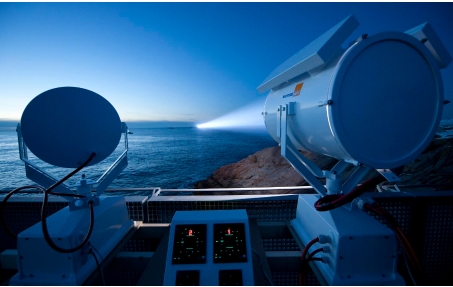
Key Design Features of Marine Remote Control Searchlights
Marine remote control searchlights are built with durability and precision in mind. Their housings are commonly made from marine-grade stainless steel, aluminum alloy, or specially coated materials that resist corrosion caused by saltwater exposure.
The lighting source often uses advanced LED technology, although xenon and halogen lamps are still found in some systems. LED searchlights offer high brightness, lower power consumption, and longer service life, making them increasingly popular across the marine industry.
Motorized pan-and-tilt mechanisms allow the searchlight to rotate smoothly in horizontal and vertical directions. Many models also provide adjustable beam focus, enabling operators to switch between wide-area illumination and concentrated long-distance beams.
Applications Across Different Marine Sectors
Marine remote control searchlights serve a wide variety of vessel types and maritime industries. On cargo ships and tankers, they are frequently used during docking, anchoring, and nighttime inspections. Fishing vessels rely on them during night operations and for locating equipment or floating objects in the water.
Patrol boats and rescue vessels depend heavily on remote control searchlights during emergency missions, where rapid target illumination can save valuable time. Luxury yachts use them to enhance navigation safety while adding convenience for owners and crew. Offshore platforms also benefit from these systems for monitoring work zones, transfer areas, and surrounding waters.

Advantages Over Traditional Manual Searchlights
Compared with manually operated searchlights, remote control models offer greater convenience and faster response. Operators can reposition the beam instantly with joysticks, switches, or integrated bridge controls. This is especially useful when tracking moving objects or scanning large areas quickly.
They also reduce physical risk by eliminating the need for personnel to work outside in strong wind, heavy rain, or icy conditions. Maintenance requirements are often lower as well, particularly with LED systems that have longer operating lifespans and fewer replacement needs.
Choosing the Right Marine Remote Control Searchlight
Selecting the proper searchlight depends on vessel size, operational environment, and intended use. Beam distance, brightness level, rotation range, voltage compatibility, waterproof rating, and construction material are all important considerations. Ships operating in extreme climates or offshore conditions may require higher protection standards and stronger corrosion resistance.
Ease of installation and compatibility with bridge control systems can also influence purchasing decisions. Many modern vessels prefer searchlights that integrate smoothly with centralized monitoring systems.
Future Development Trends
Marine remote control searchlights continue to evolve as technology advances. Intelligent control systems, wireless operation, and camera integration are becoming more common. Some high-end models now include automatic tracking features and programmable positioning functions.
LED performance is also improving, with brighter output, better thermal management, and lower energy usage. As marine operations become more digitalized, remote control LED searchlights are expected to play an even larger role in connected vessel systems.

Final Thoughts
Marine remote control searchlights have become indispensable tools for modern maritime operations. Their ability to provide strong illumination while being safely operated from inside the vessel offers clear advantages in navigation, security, and efficiency. With continued innovation in lighting and control technologies, these systems will remain a vital component of safer and smarter marine operations in the years ahead.

