What Is A Solventless Laminator

Solvent-free composite has a wide range of applications. With the advantages of environmentally friendly, hygiene, high efficiency, the solventless laminator is especially applied for the flexible packaging industry.

solventless laminator

Solventless lamination is a method for the composite of two or more substrates using a solvent-free adhesive. The solventless laminator is the equipment which can be applied for a solvent-free adhesive composite. Composite substrates mainly include BOPP, PET, NYLON, CPP, PE, VMPET, VMCPP, PVC, aluminum foil, paper, etc.

Types of solventless laminator

There’re three types of solventless laminator including types of exclusive solvent-free, the combination of solvent-free and dry compound, multifunctional combination.

Exclusive solvent-free laminator is only used for solventless composite, once molding with two-layer structure or three-layer structure. It can be classified into types of manual roll changing and automatic roll changing.

The equipment adopting the combination techniques of solvent-free and dry compound can be used for solventless composite and the coating unit can be switched. This type of equipment can be connected with two machines, thereby achieving a one-time molding of three-layer structure. For example, the first machine produces PET / AL adopting a dry compound method and the second machine can complete the composite of PET / Al and PE using a solventless method.

The Multi-function type equipment can achieve solventless, dry compound, PVDC coating, cold sealing positioning coating, hot melt adhesive coating, reverse printing, etc, through switching coating units.

Work Principle Of Solventless Laminator

The mostly used solventless laminator has a structure of two-layer composite, a single station unwinding, which mainly constitutes of an unwinding unit and coating unit as a first-layer, and an unwinding unit, a composite unit, a rewinding unit. The structure of the solventless laminating machine includes a two-roller device, a winding device, and solvent-free adhesive coating composite equipment. The outstanding feature is that after entering the composite through a special coating device, it is not necessary for drying. The solventless composite machine satisfies the requirement of a solvent-free adhesive coating,which is a significant difference from the solvent drying compound equipment. The solvent-free machine has precise control for the temperature of the coating equipment, relying on the adjustment of temperature and the viscosity of the adhesive for promoting the coating application. It is equipped with a closed-loop tension controller which can strictly control the winding tension.

Laminate Flexible Bag

For more professional introduction, please visit the article page of why choose a solventless laminator.

Key Regulations And Requirements For Navigation Lights

flashing signal light

The specific installation position, lighting angle and the brightness for the navigation light, all have special requirements. The irregular use or failure of the navigation light will transmit the error signal and caused huge obstacles for the collision prevention.

Masthead light

It is installed above on the mast of a ship or above on the centerline, showing uninterrupted in the 225 degree horizontal arc.

Sidelight

It is installed on the left and right sides of the highest boat deck. The screen of sidelight facing the light surface should be coated with the berlin black. The height of the screen is at least equal to the height of the lamp. The boat which has a length of more than 80 meters, should install red, green sidelight on the bow, stern.

Stern light

The boat stern light should be installed in the middle of the stern. The height of the light should be kept horizontally with the sidelight as possible, but can’t be higher than the height of the sidelight.

Headlight

The marine headlight is placed in the bow of the pusher barge and the height can’t be higher than the headlight.

Red-green flashing light

It is the left red, right green marine flash lighting installed above the sidelight and its flashing frequency is 50 to 70 per minute. The boats with a length of less than 12 meters can also adopt a water torch instead of red and green flashing lights and should keep light bright with clear color.

Anchor light

The marine anchor light is installed on the top of the mast with all-around flashing.

Each provision concerning the navigation light must be observed from sunset to sunrise. The signal lights can also be displayed in the situation that the visibility is poor during the day. At the time of navigation light displaying, the lighting which confuses or weakens the display performance of the signal light, can’t be allowed to display.

marine navigation lights

The Function Requirements

1. The navigation light should be waterproof and the lamp holder should have a structure that prevents its own loose. It should adopt a two-filament bulb. The control box should be in the cab and the switch of the control box should have an instruction to explain its use. The cable of the navigation light is fastened with the complete lampshade & bulb and the good & reliable ground.

2. The switch should be set on the navigation light control box, used to convert the power supply. Each navigation light should be powered by a separate branch that is placed close to the control box installed in the cab and should adopt the switch and fuse which are installed in the control box for control and protection of each insulation of these branches.

3.The navigation light control box should be powered directly from the main distribution board and emergency distribution board.

4. There should be an automatic indicator that can make an auditory or a visual alarm signal at each navigation light and there should be some measurements which are adopted to prevent the navigation light go out due to the signal light failure. The auditory and visual alarms for the failure of the navigation light control box should be provided.

The article has combed the key requirements and regulations for navigation lights and signal lights, giving an explanation for the various types and functions of the boat navigation light.

Useful Knowledge Shared For Marine Navigation Light

double-deck marine navigation lights

The marine navigation light, also known as a marine signal light, is used to show the state of ship sailing or parking, which can indicate the navigation direction at night and the size of the ships. It is an important basis for ships to adopt avoidance measures and effectively avoid collisions among ships, especially at night or in poor visibility.

The Categories Of Marine Navigation Light

The ship navigation signal system is an important part of the ship’s security and it’s an important lighting system to ensure the safety of night boating. According to the international regulations for preventing collisions at sea, the navigation signal equipment must be installed on the ship with ship navigation lights, ship signal lights and foghorn. The navigation lighting system includes headlight, sidelight, stern light, towing light, anchor light, yellow all-round flashing light, maneuvering signal light and flashing light.

Headlight

The ship headlight is white light placed above the centerline of a ship, showing uninterrupted in the 180 degree horizontal arc.

Sidelight

The sidelight generally refers to the green light on the starboard and the red light on the portside. Each light is showing uninterrupted in a 112. 5 degree horizontal arc.

Stern light

The marine stern light is the white light which is installed on the place as close to the stern as possible.

Towing light

The boat towing light refers to the yellow light placed as close as possible to the stern, showing uninterrupted in the 135 degree horizontal arc.

Anchor light

The anchor light is a type of boat signal light, which is displaying uninterrupted in a 360 degree horizontal arc.

Flashing light

A marine flashing light is a signal light that is flashing with the frequency of 120 or above 120 per minute.

Navigation light indicator

It is an indicator centralized control of the on-off of the navigation lights and a device that can give an alarm when the navigation lights fail.

For more detailed introduction, please visit the article page of Basic explanation for marine navigation light.

High Holding Power Anchor With Great Gripping Force

TThe anchor has a large holding power to weight ratio, so it is called a high holding power anchor. The gripping force is more than two times larger than the ordinary stockless anchor of the same weight. There are Martrosov anchor, Danforth Anchor, Schdringer anchor, Staccato anchor, etc.

A high holding power anchor is classified into a stocked anchor and a stockless anchor. Its general feature is that the anchor fluke is wide and long with deep gnawing soil, good stability.

1.Stocked high holding power anchor

The typical kinds of this anchor are the Danforth anchor and Steven anchor.

The anchor head is provided with a stabilizer bar to ensure stability, generally suitable for more soft substrates, with inconvenient storage, so this type of HHP anchor is suitable for engineering ships and small ships.

Danforth anchor

The danforth anchor is also known as swallow anchor and the anchor fluke is rotated about 30 ° back and forth. The holding power to weight ratio is generally greater than 10, mostly used in engineering vessels.

danforth anchor

Steven anchor

The anchor has a short and large fluke, and the maximum angle of the anchor fluke can be adjusted by the movable wedge mounted on the anchor rod to accommodate a variety of substrates. The holding power to weight ratio is 17 to 34, widely used as a positioning anchor for oil platforms.

2.Stockless high holding power anchor

The stockless HHP anchor is developed by the stock HHP anchor. It has improved the anchor fluke of the stockless anchor. The typical stockless high holding power anchor is the AC-14 anchor developed by the United Kingdom and the Boer anchor developed by the Netherlands.

AC-14 anchor

The AC-14 anchor is a commonly used anchor. The anchor fluke can have an allowable deviation for the left and right corner within 1 degree. AC-14 anchor is a casting anchor with black painting surface treatment. It has the advantages of stable structure, thick and wide flukes, adaptability to various substrates, rapid gnawing, high gripping stability with holding power to weight ratio ranges from 12 to 14. So it is commonly used as the bow anchor in the large ship or ro-ro ship.

AC-14 anchor

Boer anchor

The Boer anchor also called TW type anchor or N type anchor. It has smooth and sharp anchor flukes, with the advantages of adapting to a variety of substrates, high stability, convenience for dropping and weighing anchor, easy for storage, suitable for the bow anchor in a large ship and positioning anchor in a workship.

TW type anchor

The high holding power anchors, which include Danforth anchor, AC-14 anchor, TW type anchor, etc, have the advantages of great gripping force, deep gnawing, high stability, commonly used in a wide variety of ships.

Why Should Choose Marine Anchor For Berthing

The boat is difficult for berthing when encountering the strong wind. It completely relies on boat anchor. The marine anchor is the main component of the anchoring and mooring system. One end is fixed on the boat with a marine anchor chain and the other end is a barbed claw shape, throwing to the bottom of water or shore to highly stabilize the boat.

Work Principle Of Marine Anchor

Marine anchor is composited of anchor buckle, anchor bolt, anchor stock, anchor handle, anchor wrist and the symmetrical part on both sides is called anchor fluke which is the most important part of the anchor to grab into the dirt. After the ship is anchored, the anchor is sinking to the bottom of water under the traction of the anchor chain. The plane where the anchor wrist is located is perpendicular to the water bottom with the anchor rod. At this time, the anchor fluke will be in contact with the bottom of the water.

The length of the ship anchor chain is often longer than the depth of the water, so the anchor chain in the water bottom has a lying- flat state. When the ship is disturbed, the anchor chain will be pulled. The anchor in the bottom of the water under the action of the horizontal force. The role of the anchor itself acts on the contact point of the anchor fluke and the water bottom. The two-force synthesis makes an anchor move downward, which is anchoring the process. After that the anchor is pulled into the bottom of the water, which can provide the ability for boat berthing.

The Categories Of Marine Anchor

The factors that should be considered for choosing the marine anchor include easy operation, convenient to store and economic application. The most important factor is the anchor grip. The anchor grip is different because of the anchor type and the submarine soil.

There are many kinds of marine anchors. According to the different structures and uses, the ship anchor can be classified into a stocked anchor, stockless anchor, high holding power anchor and special anchor. The bow anchor adopted by the merchant ship is a stockless anchor, while the stern anchor sometimes adopt a stocked anchor or a Danforth anchor.

1. Stocked anchor

The anchor has the advantages of a simple structure, large holding power to weight ratio and high grip stability, but it has inconvenient anchoring operation and storage with an anchor stock. Therefore, this anchor should not be used as a bow anchor for commercial ships, suitable as a stern anchor, generally used for small boats.

2. Stockless anchor

It is also known as the hall’s anchor and the generally adopted stockless anchors for merchant ship are Hall anchor and Spek anchor. The anchor fluke and anchor rod can rotate at a certain angle and is a stockless type. The holding power to weight ratio is 2.5 to 4 and the maximum is up to 8. The anchor has a simple structure, throwing anchor operation and storage conveniently, so it is suitable for the bow anchor with the widest applications. But it also has the disadvantage of a small anchor grip. The Hall anchor is the earliest used type and the Spek anchor is an improved type of Hall anchor, which has the advantage that its anchor fluke can be naturally upward.

hall anchor

3.High holding power anchor

It is combined with the advantages of a stocked anchor and a stockless anchor. Because of the large gnawing soil of the anchor fluke and the large gripping force, it is suitable for the sandy or soft water bottom. The commonly used HHP anchors are the Martrosov anchor and Danforth anchor which is characterized by the deep gnawing soil, high stability, with large anchor grip. But the strength of the anchor fluke is weak and easy to deform.

high holding power anchor

4.Special anchor

It has different shapes, compared to the general anchors, such as single claw anchor, screw anchor and mushroom anchor. It often has special applications, used in a permanent mooring such as a floating tube, a buoy, a lightboat, the floating dock and a floating wharf.

For more professional knowledge, please visit the article page of What is a marine anchor

Material Properties Of Tungsten Carbide

carbide wear parts

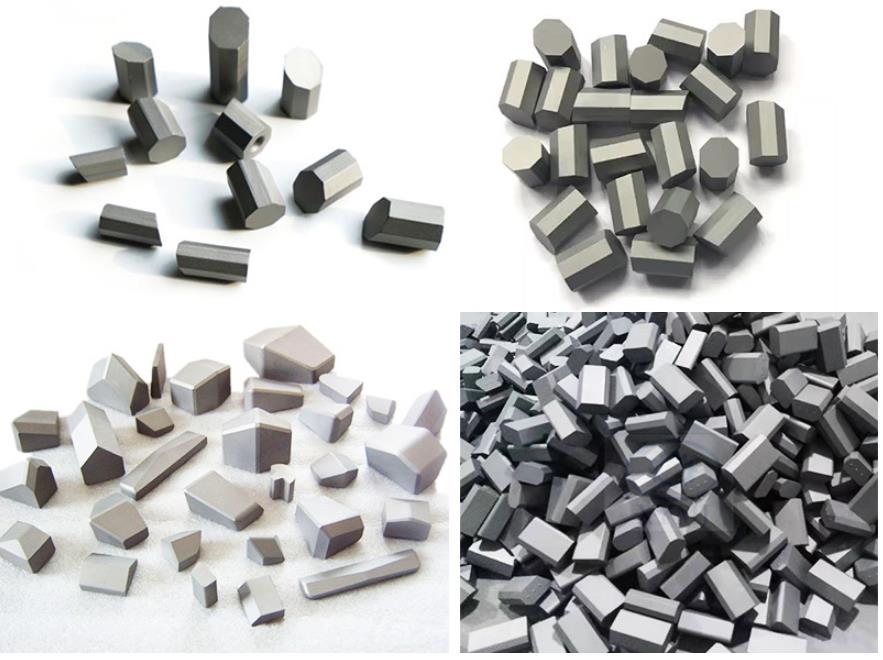
Tungsten carbide is made of refractory metal hard compound (hard phase),which is generally a carbide, and metal binder (binding phase)obtained by powder metallurgy method,. As a hard alloy for cutting tools, the commonly used carbides are tungsten carbide (WC), titanium carbide (TiC), and tantalum carbide(TaC), niobium carbide (NbC), etc. The mostly used binder is Co. The strength of the tungsten carbide depends mainly on the content of cobalt.

Because of the high melting point,high hardness, good chemical stability, and good thermal stability that carbides in the cemented carbide have and the large amount of high-temperature carbon materials, the hardness and resistance Abrasiveness and heat resistance are higher than high speed steel.

The main component of the hard alloy hard phase is WC. WC has good wear resistance.although some carbides have the same hardness and WC, but do not have the comparable wear resistance. Besides,WC has a higher yield strength (Table 1-2), so its resistance to plastic deformation is better. WC has good thermal conductivity, which is one of the most desirable properties for making tool materials. In addition. WC has a low coefficient of thermal expansion that is about 1/3 of steel.WC’s modulus of elasticity is three times that of steel, and its torsional modulus is twice that of steel. Therefore, the compressive strength of cemented carbide is also higher than that of steel. In addition, WC has good corrosion and oxidation resistance at room temperature, good electrical resistance, and high flexural strength. these excellent properties of WC have been passed to a hard alloy with its main component.

Compared with high speed steel, the hardness of cemented carbide is HRA89-94, which is much higher than the hardness of HSS (HRC63-70 or HRA83-86.6). The maximum cutting temperature allowed for tungsten carbide can reach 800-1000 °C or more, which could be much higher than HSS’s (550-650 ℃). The high temperature hardness of cemented carbide could be HRA82-87 at 540 °C,which is the same as the normal temperature hardness of high speed steel. The hardness at 760 ° C is HRA 77-85, and can maintained in HRA 73-76 at the environment of 1000-1100 ° C. Besides, Carbide’s wear resistance of cemented carbide is 16-20 times higher than that of the best HSS. Due to its high temperature hardness and wear resistance, cemented carbides have much higher cutting performance than high-speed steel and can increase tool durability by several tens of times. When machining ordinary structural steel, the cutting speed allowed is 4-10 times higher than that of high speed steel tools.

Tungsten carbide is widely used as tool materials, In the turning process, except for a small number of small diameter bores and some non-ferrous metal workpieces, almost all of them can be processed with carbide turning tools. In the drilling process, in addition to the existing carbide drills, carbide drills, deep hole drills, carbide injection drills and indexable carbide drills have also been successfully used to machine steel. In addition, carbide end mills have been widely used. Others such as reamer, end mill, small modulus gear hob, medium and large modulus gears for hard tooth surfaces, broaches and other tools use hard Alloys are also increasing. Although the proportion of cemented carbide in tool materials is lower than HSS and ranks second, its proportion of cutting chips is as high as 68%. According to reports, in some countries, more than 90% of turning tools and more than 55% of milling cutters are made of tungsten carbide, and this trend continues to grow.

Why Choose cemented carbide as the material of mining tool

An excellent hard alloy for mining should have high strength, high hardness required for abrasion resistance and high toughness required for resistance to impact fracture. Because of the high hardness, wear resistance, and stable chemical properties, tungsten carbide mining tool is widely used.

tungsten carbide mining buttons

1. Wear resistance of WC alloy

The shearer of the shearer is in direct contact with the coal seam during the working process. The abrasive wear characteristics of the shearer are closely related to the coal seam structure and hardness. The hardness of the coal is low, generally 100 to 420 HV, but the coal often contains different hardness. Impurities such as quartz and pyrite (900 to 1100 HV) have high hardness and have a great influence on the abrasive wear characteristics of picks.

In most of the operating examples, wear resistance is a basic function of material hardness. The higher the hardness, the higher the abrasive wear resistance. Pure WC is very hard and similar to diamond. In cemented carbide, WC particles form a strong skeleton, so WC cemented carbides exhibit very high hardness. In addition, WC belongs to the hexagonal crystal system and has anisotropy in hardness. The Vickers hardness of the bottom surface and the edge surface is 2 100 HV and 1 080 HV, respectively. In the coarse-grained cemented carbide, the proportion of WC grains on the plane is high, and thus the carbide containing the coarse-grained WC shows higher hardness. At the same time, at a high temperature of 1 000°C, coarse-grained WC hard alloys have higher hardness than ordinary hard alloys and show good red hardness.

In the coal cutting process, WC particles are exposed on the surface of the cemented carbide after cemented phases of the cemented carbide in the tool nose protected by the built-up edge have been squeezed away or are carried away by abrasive scraping. Bonded phase-supported WC particles are easily crushed, destroyed and released. Due to coarse WC grains, the cemented carbide has a strong holding force with respect to the WC, and the WC grains are difficult to pull out and exhibit excellent wear resistance.

carbide mining tips

2.Toughness of WC Alloy

When the cutter bit cuts the coal rock, the cutter head is subjected to high-stress stress, tensile stress and shear stress under the action of the impact load. When the stress exceeds the strength limit of the alloy, the alloy cutter head will be fragmented. Even if the generated stress does not reach the strength limit of the cemented carbide, the fatigue cracking of the cemented carbide will occur under the repeated action of the impact load, and the expansion of the fatigue crack may cause the tool head to fall off or chipping. At the same time, when cutting the coal seam, the shearer pick produces high temperature of 600-800°C on the cutting surface, and the cutting cutting coal seam is a periodic rotary motion. The temperature rise is alternating, and the temperature increases when the cutter head contacts the coal rock. , cool down when leaving the coal rock. Due to the constant change of the surface temperature, the dislocation density increases and concentrates, and the surface of the serpentine pattern appears.

The depth of cracks and the rate of propagation decrease with increasing carbide grain size, and the morphology, direction, and depth of cracks also vary with WC grain size. The cracks in fine-grained alloys are mostly straight and small and long; coarse-grained alloy cracks are irregular and short. The cracks mainly extend at the weak grain boundary. In the coarse-grained cemented carbide, if the micro-cracks bypass the coarse-grained WC grains, they are zigzag-shaped and must have energy that matches the fracture area; if they pass through When WC grains are expanded, they must have considerable fracture energy. As a result, the coarse-grained WC grains have enhanced deflection and bifurcation of cracks, which can prevent the further propagation of micro-cracks and increase the toughness of the cemented carbide. With the same content of cementitious phase, the coarse-grained alloy has a thicker bonding phase, which is beneficial to the plastic deformation of the bonding phase, inhibits the extension of cracks, and shows good toughness.

Studies on the strength and structure of WC-Co cemented carbide also show that there is a certain rule between the strength of tungsten carbide and the grain size of WC. When the cobalt content is constant, the strength of conventional low-cobalt alloys always increases as the grain size of WC in the cemented carbide becomes coarser, and the strength of the alloy with higher cobalt content peaks with WC grain coarsening.

CNC Milling

CNC Milling is a very important part in a part producing process, it provides precise slots or ribs of various sections, flat surface in vertical, horizontal and inclined planes, surfaces of revolution, helical grooves and more. Compared with CNC turning, CNC milling, especially 5 axis milling can be used to create complex 3D shapes or to apply a machined surface or features to parts made both plastics and metals. The advantage of multi-axis milling machines makes CNC milling process versatile, as well as accurate and repeatable, for creating many different types of part features of complex geometries. Example include holes, curves, slots, angled shapes, and channels. Milling is also ideal for making tooling for pressure die casting and plastic injection molding.

Metal Casting Service

JTR Machine offers industrial metal casting services for Aluminum, Steel, Zinc, etc. Capable of both mass production and prototyping, JTR Machine has provided many high-precision prototypes and end-use parts to our clients. JTR CNC machining is available to combine with metal casting and produce parts with finer surface details (surface finishing available, too). Best solution for large volume parts production, contact us and get an instant quote.

通过 WordPress.com 设计一个这样的站点
从这里开始