Regardless of iron, aluminum or steel, the blades will cut them into the desired shapes when machining. The tungsten carbide blades are made of cemented carbide as the basic materials which is an alloy material hard made with hard compounds of refractory metals and bind metal through the powder metallurgy process.
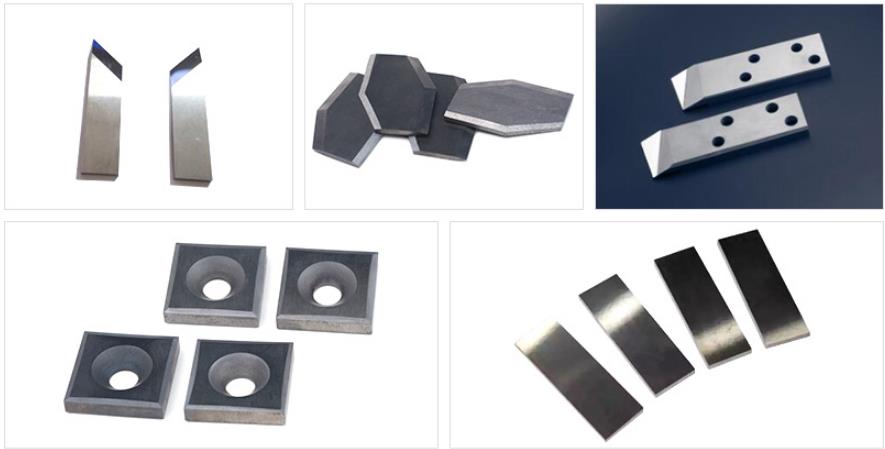
Material Performance Of Tungsten Carbide Used As Blades
The tungsten carbide blade, also known as carbide tips, mainly adopts the overall hard alloy as the matrix and it is fine finished through various kinds of production processes. Carbide blades have extremely high hardness and high strength, excellent high wear resistance, high elastic modulus.
The tungsten carbide is distinguished according to the grain size, which can be divided into ordinary type, fine grain, sub-fine grain, ultra-fine grain, newly launched double-grain. According to the main chemical composition, cemented carbide can be classified into three types including tungsten cobalt (YG), titanium-tung-ste (YT), and adding rare carbonization (YW).
The tungsten carbide has a high hardness of 86 ~ 93HRA, equivalent to 69 ~ 81HRC, second only to diamond, good heat hardness of up to 900 ~ 1000 ° C, keeping 60 HRC, the high bending strength of MPA5100, good impact toughness and high corrosion resistance. The general alloy blade does not have these characteristics.
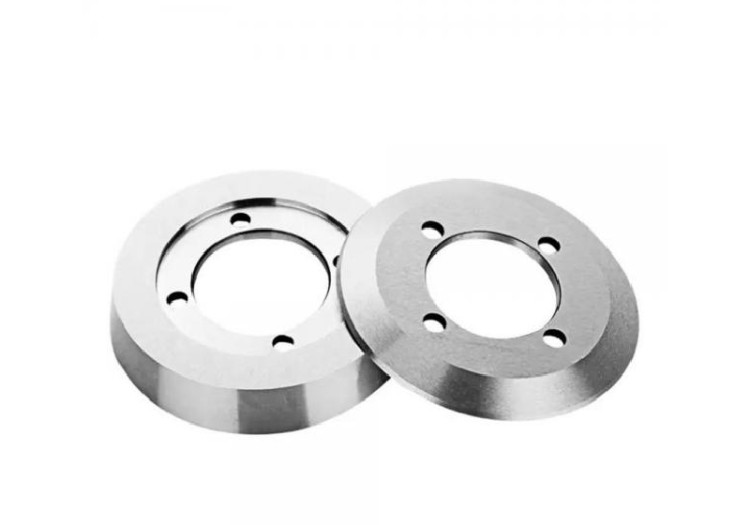
The Production Process Of Tungsten Carbide Blades
1. Ingredient
The main component of the cemented carbide blade is a different ratio of tungsten carbide and cobalt and the initial form of the raw material is the powder. The container is filled with a prepared raw material, which will be used to produce different powders.
2. Proportion
In the workshop, the dried raw materials are mixed with ethanol and water to form a grey pulp.
3. Open mold
After the grey pulp is dried, the sample is sent to the laboratory for quality detection. These powders are consisted of many particles having a diameter of 20 to 200 μm.
4. Press
These powders are contained in a bucket with the capacity of 100 kg, to be delivered to a punching machine for manufacturing a blade. Operation workers place the stamping dies into the machine tool. The pressure used for stamping each blade is as high as 12 tons. The machine tool will weigh the blade, and the operator will also perform observation and control. At this period, the blade is very fragile.
5.Sintering
For hardened, the blade after stamping needs to be heated. This work is done by the sintering furnace. Thousands of blades can be processed at a time. The pressed blade powder is heated to about 1,500° C for 13 hours. The shrinkage ratio of the sintering process is about 50%.
6. Waiting for grinding
Complete the required thickness of the quality inspection in the laboratory. Because the tungsten carbide is very hard, it is necessary to adopt industrial diamonds for grinding.
7. Grinding
When the blade reaches the required thickness, it is further grinded to obtain geometric shapes and sizes. Tolerance requirements are extremely stringent.
8. Coating
After the grinding is finished, the blade will be cleaned and sent to the coating. At this period, in order to avoid any oil grease or dust, the gloves must be worn for dealing with the blade and then sent into a coating furnace with lower pressure for different colors.
 China manufacturers