Industrial workbench offers great flexibility in terms of design. For selecting the ideal industrial workbench, you need to consider carefully about the kind of work, space, storage, accessories, etc. Sanji-first is an online professional industrial workbench manufacturer , you simply need to let them know your requirements and the various constraints and they will design an ideal workbench for you.
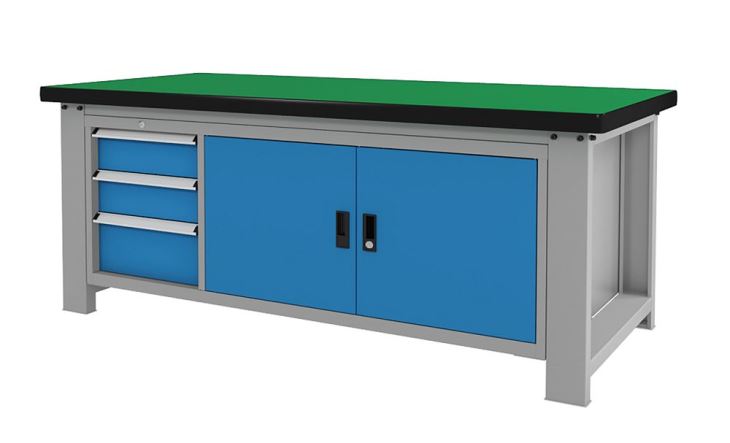
Workplace
One overriding consideration will affect every aspect of your workbench selecting decision: What work will you be performing on it? The answer will affect everything from the size of the bench to the surface material, storage requirements and ergonomic considerations.
Once you determine what will be done on the bench, analyze the tasks associated with the work and make a checklist of features needed to perform them. For example, say you’re in the business of assembling and maintaining cell phones, and you need to furnish a workspace for your repair technicians. You want a small workbench, perhaps one that is height-adjustable to bring a detailed repair job up to an optimal work distance. Along with the workbench, you will need excellent lighting. You’ll likely also need bins above the work surface to provide direct access to small parts, and an articulating arm that can hold assembly guidelines or diagrams. Depending on the flow of your repair operations, you might want to consider a material-transfer work surface or even a conveyor workstation, both of which can cost-effectively expedite material handling.
Or maybe you’re working in a pharmaceutical lab, where the work surface material becomes a more important part of the decision. Depending on the liquids and solids you’re handling, you might want either a stainless steel or epoxy resin chemical-resistant work surface for durability. If your laboratory is in a clean room, your laboratory Workbench will need to meet certain health and safety standards. You might also need to store small beakers, instruments and large testing equipment-requiring a variety of storage spaces above and below the work surface.

Take advantage of the space
The size of your workbench is determined by a number of factors. First up is how much space is available in the work environment-how big a footprint will the bench occupy? Because today’s modular workbenches maximize the use of vertical space, you may not need as big a workbench as you think. Next, how much work surface does your application demand, both in terms of width (left to right) and depth (front to back). Does the entire work surface need to be within easy arm’s reach? Can you position items above the work surface on a vertical accessory system for easier access? Will you be working with large equipment or parts? If so, you may not only need a larger work surface but might also need to factor in the weight-bearing capacity of your workbench.
After thinking about size and footprint, you should consider whether your company’s workflow is best served by a group of workstations laid out in a particular configuration. Some companies offer modular workstations that accommodate different configurations, and thus different types of workflow. Use a design that positions your team for maximum efficiency.
The storage volume
Spend some time doing some careful planning to get a workstation that exactly addresses your storage needs with little or no wasted space. Simplify your storage decisions by reducing the items being stored to only those that directly address your workbench applications. When doing your planning exercise, consider the size, shape, weight, quantity and fragility of the items to be stored, as well as how accessible they need to be, and how much security they demand.
Light
The lighting needs for different tasks are an important consideration. Does each station need separate lighting? Does the room itself have lighting deficiencies? Does the light cast an unwanted colour? If you need an industrial workbench with light, are your technicians best-served by overhead fluorescent lighting or a swing arm that can be easily positioned or moved out of the way when not needed? Do you need an accessory that can diffuse the light and reduce glare?
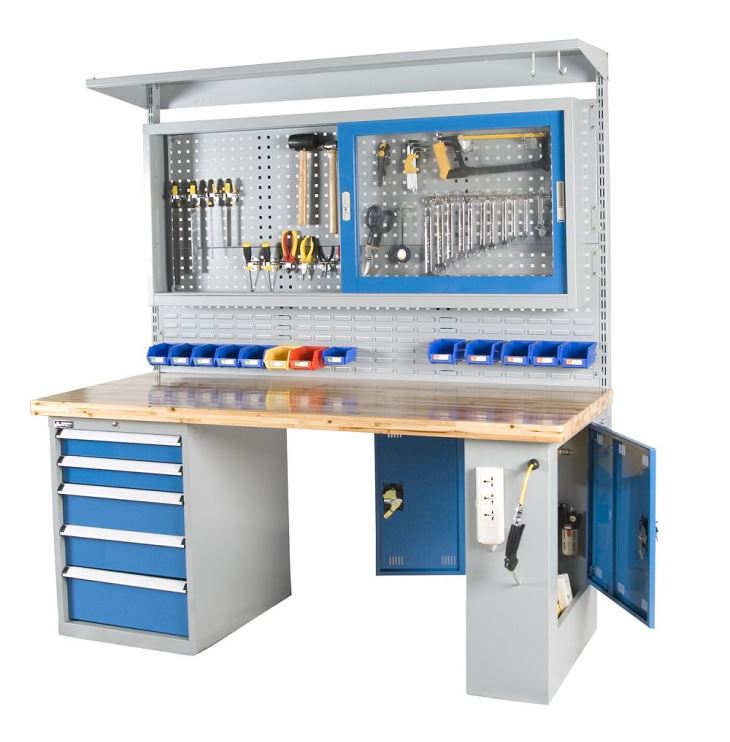
After you weigh your lighting needs, consider your electrical requirements next. From cleanrooms to quality control departments to research and development, having a convenient source of power at each workbench with light can be essential. There are diverse options to consider-from power beams and air beams to air supply brackets and cable management accessories. You can narrow your selections down to the necessary few by asking the right questions.
The right accessories
Think about the impact that accessories might have on improving the work functions of the industrial workbench. No matter what the task, there’s an accessory to help get the job done more efficiently and conveniently. By taking advantage of the abundant vertical space above the work surface, and the many interchangeable accessories available, you can create a highly efficient work centre that is tailored completely to the jobs being performed in the workspace. Examples include shelving for manuals or instruments, parts bin rails, a monitor bracket or a keyboard holder.
Most companies have multiple departments, from manufacturing to testing to shipping. Consider using a common workbench platform throughout the facility to gain such benefits as better utilization of inventory, easier reconfiguration, interchangeability of accessories, and aesthetic appeal.
 China manufacturers