The ESD workbench can be seen to consist of a number of different elements:
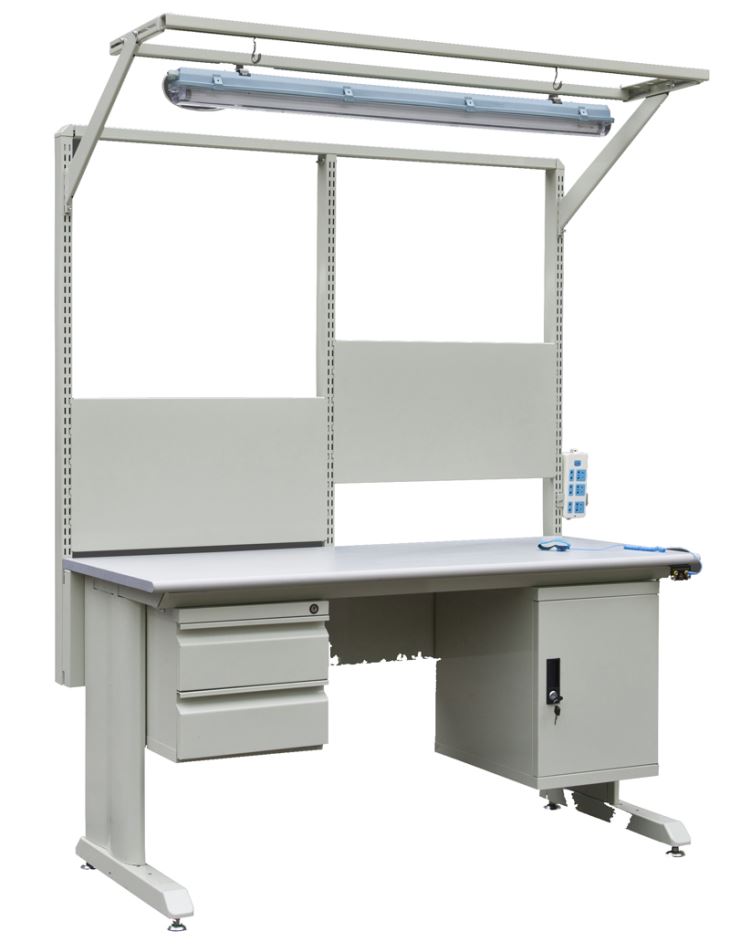
Static dissipative work surface: The primary element of any ESD workbench is the static dissipative work surface.
Shelves: As static can build up anywhere on a workbench, it is essential that all elements of the bench are static dissipative. As items, either electronics assemblies or tools may be placed here the shelves need to be part of the ESD protected area. Also if tools are placed on a non-ESD dissipative surface, attract static, and then they are used to work on an electronics assembly, then the damage could result.
Metalwork: While the metalwork itself is conductive, the paint used is not normally conductive. For an ESD workbench, it is necessary to use static dissipative paint to prevent any sudden discharges.
Cupboards: Many workbenches have cupboards attached to them as an integral element for tidy storage. In view of the fact that electronics assemblies or other items such as tools for working on the assemblies may be stored in these cupboards, it is essential that the cupboard conforms to the same ESD standards as all other areas. Shelves should have static dissipative surfaces and any painted metalwork should have a static dissipative paint finish.
ESD wrist straps: When working at an ESD workbench, it is necessary to ensure that the operator is also held at the same potential so that no discharges occur. ESD wrist straps are generally used for this.
Wiring: It is necessary to ensure that all static dissipative surfaces, wrist straps, etc are all connected to a common grounding point, and wired in a suitable manner. It is essential that this is achieved effectively and in the correct manner from the viewpoint of electrical safety.
Monitoring system: With wires such as the connections to ESD wrist straps, etc being in almost constant use there will be periodic failures. One method that has been adopted is to test ESD wrist straps and their wires each day. However, when a problem is detected, it is possible that the operator has been causing damage to assemblies since the last time the ESD wrist strap was tested. To overcome this problem, continuous monitoring systems are available which are considerably more satisfactory. These are typically incorporated into the ESD workbench assembly.
Care and maintenance of the ESD workbench
With a good dissipative surface on an ESD workbench it is necessary to use and maintain it for it to provide a long effective life. Apart from testing which is covered in the paragraph below, there are a few simple steps that can be taken to ensure the ESD workbench provides a long and useful life.
Avoid damaging the ESD dissipative surface of the workbench with sharp objects as these can significantly reduce the effectiveness of the surface, particularly if small areas become isolated by cuts, etc.
Clean the surfaces periodically to prevent the build-up of grease or other layers that will impede the static dissipation. A plain cotton rag or cloth, with diluted ammoniated detergent, is ideal. Using this, ensure that all dirt films are removed from the surface. It is always best to consult the manufacturer’s literature for the best methods for their particular surface.
Never use wax-based cleaners or solvents that may attack the surface or modify its properties.
Never use abrasive cleaners. This can include abrasive cleaning agents as well as abrasive cleaning pads such as kitchen scourers. These can remove or damage the ESD dissipative surface and considerably impair its action.
It is worth implementing a regular care and maintenance schedule as dirt and grease can build up on an ESD dissipative surface over time and its performance gradually reduce. As it is difficult to visibly detect any performance degradation, and any effects may come on gradually and not be noticed, the only way to overcome this is to regularly clean and maintain the surface. Testing should also be incorporated into this schedule.
Testing of the ESD workbench
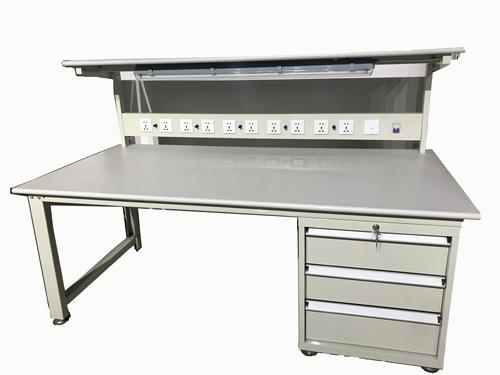
In addition to cleaning of the work surface, periodic testing of the ESD workbench is required. This ensures that after repeated use of the connections and general infrastructure of the bench, everything is within its required tolerances and no breaks of connections are present.
Often monitors are used to ensuring that wrist straps and their connections are properly operational, but periodically a complete electrical test of the bench including its ESD performance is needed.
ESD workbenches are widely used for research and development laboratories, production test areas, service and repair areas and many more. The use of a proper ESD safe Workbench is necessary to ensure the ESD protected area is completely operational.
 China manufacturers