Forged steel rolls refer to the rolls produced by forging. Forging can forge metallurgical defects such as looseness and shrinkage inside the steel ingot and crush the cast structure to obtain high-quality rolls with dense structure and uniform composition. The rolls have better toughness, surface hardness uniformity and fatigue resistance than cast steel rolls. In order to meet the specific requirements of different rolling mills and rolling conditions, different elements can be alloyed to the roll for high performance. The production process of forged steel rolls includes smelting, ingot casting, forging, post-forging heat treatment, rough machining, final heat treatment and finishing. The equipment used for the production of forged rolls and the process parameters must mmet the requirements for the chemical composition, mechanical properties, organization, metallurgical quality, dimensional tolerances, internal stress distribution, and surface state. A certain amount of carbon and alloying elements have different effects on the structure and properties of the forged rolls. Carbon can increase roll hardness and strength and reduce plasticity, improving wear resistance. manganese can increase hardenability and strength. Silicon acts as a deoxidizer increasing strength. Molybdenum can increase hardenability and thermal hardness. Vanadium can control the grain size of steel and increase strength.
Forging Steel Roll
Forged steel rolls have toughness, surface hardness uniformity and fatigue resistance and widely used to the cold rolling mill. The rolls are made from steel ingots by forging. Forging can solve metallurgical defects such as loose and shrinkage holes in the ingot, and crush the coarse cast structure to obtain a high-quality roll with dense structure and uniform composition. The production process of forged steel rolls includes smelting, ingot casting, forging, post-forging heat treatment, rough processing, final heat treatment and finishing. The rolls are heat-treated differently depending on the material and application. They are mainly used as strip rolling mill working roll and backup roll, H-type steel universal–shaft, High-speed roll(HSS roll), Cr4 steel backup roll, Cr5 forged steel roll. The forged steel rolls produced by TINVO have the standards of ISO, GB, ASTM, DIN, JIS, OEM and ODM available.
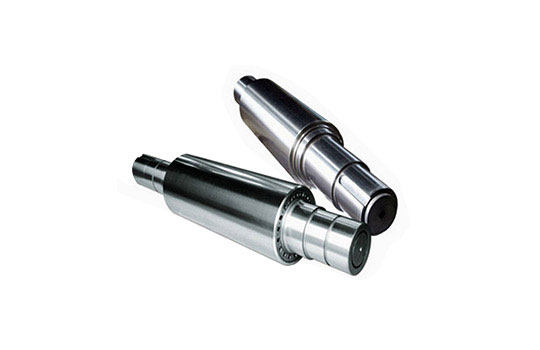
Forged steel rolls have better toughness, surface hardness uniformity and fatigue resistance than similar casting rolls. In order to meet the specific requirements of different rolling mills and rolling conditions, different alloy elements can be added into the steel for improving the performance of rolls.
Application
Cold rolling mill work roll and strip rolling mill working roll and backup roll
H-type steel universal –shaft
Hi-speed steel mill roll
Cr4 steel backup roll
Cr5 forged steel roll
86CrMoV7 forged steel roll
42CrMo forged steel roll
MC2, MC3, MC5, MC6 forged steel roll
Backup Roll
The back up roll is a roll that supports the work roll and is the largest and heaviest roll used in rolling mills. The roll can support intermediate roll for the purpose of avoiding deflection of the work roll and affect on the yield and quality of the plate and strip rolling mill. The quality characteristics of the backup roll are high surface hardness, good hardness uniformity and the deep hardened layer of roll body, good strength and toughness of roll neck and roll body. the backup roll has high wear resistance and peeling resistance, strong anti-accidents. The forged steel rolls of 1000mm or less are made of 86CrMoV7 and 9Cr2Mo. Its carbon content is 0.80% to 0.95% and Cr content is 2%.It can be used for some small mills. Cr4 and Cr5 back up rolls have a carbon content of 0.4% to 0.6% and a Cr content of 4% to 5%, suitable for high-speed steel and semi-high-speed steel work rolls.
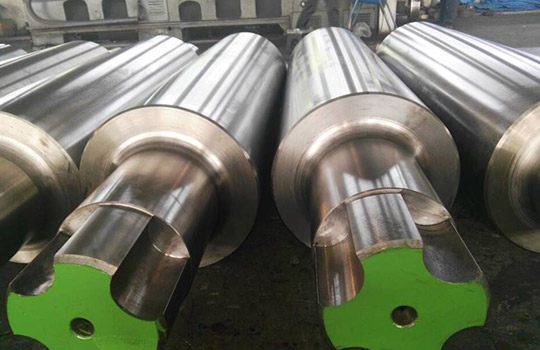
For some small mills, the forged steel back up rolls of 1000mm or less are made of 86CrMoV7 and 9Cr2Mo, its carbon content is 0.80% to 0.95% and Cr content is 2%.
The steel for Cr4 and Cr5 backup rolls has a carbon content of 0.4% to 0.6% and a Cr content of 4% to 5%. The hardened, wear resistance, peeling resistance, fatigue-resistant and anti-accident properties of the backup rolls basically eliminate the peeling phenomenon of the roll body surface and the roll cutoff accident. Cr4, Cr5 steel backup rolls are suitable for high-speed steel and semi-high-speed steel work rolls.
Application
Bar rolling mill, splitter mill rack, high-speed wire rod finishing mill, hot-rolled narrow strip finishing mill, section and groove steel rolling mill
Production Flow
Roll blank manufacturing → Roll blank acceptance → Annealing → Rough turning → Ultrasonic flaw detection → High temperature quenching → Low temperature tempering → Ultrasonic flaw detection → Finishing → Ultrasonic flaw detection → Grinding roll body → Rolling number → Inspection → Cleaning → Packaging → Shipping
Main Standards
GB/T 13313-2008 Shore and Leeb Hardness Test Methods For Roller
GB/T 1503-2008 Cast Steel Roll
 China manufacturers