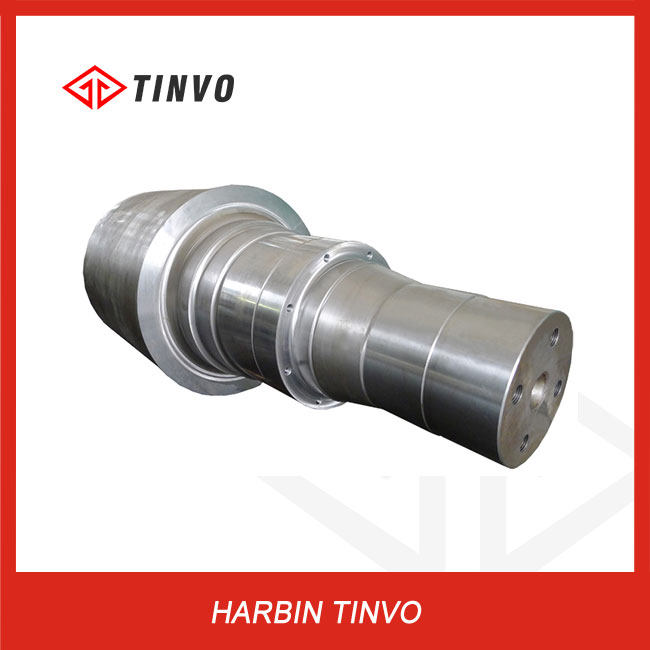
Forged Steel Shafts have many industrial applications such as pump shafts, valve stems, cylinder rods, eye bolts, studs, motor shafts, input/output shafts and rolls.
TINVO manufactures open die forged shafts in an assortment of geometries and a wide range of materials. Forged shafts are used in any application that endures high stress, impact strength, long fatigue life and high temperatures. Forged shafts have economical and quality advantages as opposed to machining shafts from bar stock. A shaft can be forged to near net shape with varying geometries saving on material cost and machining time. Additionally, a shaft forged to near net shape will benefit from the forging process and have a grain flow following the forged configuration of the shaft thereby yielding outstanding grain structure and the best combination of mechanical properties.
Capability:
Max Diameter: 1000 mm
Max Length: 9000 mm
Max Weight: 40 T
Tolerance: 0.01mm
Material:
Carbon Steel: ASTM A105, ASTM A350 LF2 :
ASTM A694 F42/F50/F60/65/F70 S355J2G3
Alloy Steel: F1,F5,F9,F11, 4130, 4140,8620, 20CrMnMo, 42CrMo4,34CrNiMo6, 18CrNiMo7-6 etc.
Stainless Steel: F321,F304,F304L,F316, F316L, F312L,F321, F347, F347H.
Double Stainless Steel: 1.4462, F51, S31803; F60, S32205; F53, S32750
Hastelloy: Inconel 625 & Monel K500
Process:
Raw Material Inspection →Cutting→ Inspection → Preheat → Forging → Heat Treatment → Inspection → Rough Machining → NDT →Testing → Finishing Machining →NDT →Inspection → Packing→ Delivery.
To learn more knowledge professional knowledge, please visit the product page of Mill rolls.
 China manufacturers